








Portuguese engineering firm MCA Group has inaugurated what it says is Africa’s largest off-grid solar park in Angola’s Luau municipality — marking a major milestone for renewable energy development along the strategically important Lobito Corridor
The opening of the €87mn Luau Photovoltaic (PV) Park was attended by Angolan President João Lourenço and Energy and Water Minister João Baptista Borges.
The facility has a generation capacity of 31.85 MWp and battery storage of 75.26 MWh, supplying electricity to more than 90,000 people without relying on fossil fuels.
According to MCA, the project surpasses the capacity of the nearby Cazombo Solar PV Park, previously regarded as the continent’s largest off-grid installation.
Together, the two projects form part of Angola’s wider Rural Electrification Programme, which aims to deploy 46 autonomous solar mini-grids across 60 communes by 2027, potentially benefiting more than one million people.
MCA’s chairman Manuel Couto Alves called it an important step in Angola’s energy transition as it expands solar power capacity throughout the country.
“The completion of the Cazombo and Luau parks marks just the beginning of a structural and ambitious programme which will continue to expand in the coming years,” he said.
“We believe that energy transforms lives, creates opportunities and strengthens regions, and it is with this aim that we will continue to work, side by side with the communities, to ensure that electrification reaches where it makes the most difference.”
The Luau facility includes nearly 55,000 solar panels and is expected to save around 18 million litres of fuel annually while reducing carbon emissions.
The project, which created more than 200 local jobs during construction, was jointly developed with Angola’s state-owned utility PRODEL EP, while financing was arranged by Standard Chartered Bank with support from German export credit agency Euler Hermes under the European Union’s Global Gateway infrastructure strategy.
Read more:
Elgin Orchards pure-air switchgear project
MCA unveils Angola’s Luau solar park
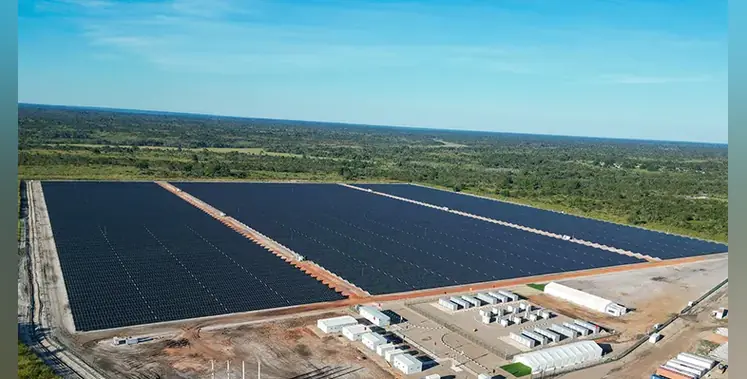
Laua solar park to boost Angola's clean energy sector (Image source: Adobe Stock)