








Toyota Tsusho Corporation has announced that, through its Group company AEOLUS SAS, it has completed construction of two solar power plants in Tunisia with a combined capacity of 100MW, and both facilities have now entered commercial operation
The development marks Toyota Tsusho’s first renewable energy project in Tunisia and the first investment project undertaken by AEOLUS.
The two plants were developed in Tunisia’s Sidi Bouzid Governorate and Tozeur Governorate through an operating company financed by AEOLUS and Scatec ASA, a Norwegian company specialising in the construction and operation of solar power facilities.
The Sidi Bouzid Mezzouna PV Power project, with a capacity of 50MW, commenced commercial operations on January 1, 2026. The Tozeur PV Power facility, also rated at 50MW, began commercial operations on March 4, 2026.
Together, the two plants are expected to provide electricity equivalent to the yearly consumption of around 120,000 Tunisian households. The project is also projected to reduce carbon dioxide emissions by approximately 108,000 tonnes annually. Power generated from the facilities will be supplied to the Tunisian Company of Electricity and Gas under a 30-year agreement.
Both solar projects were selected under the Ministry of the Environment, Japan Financing Programme for Joint Crediting Mechanism (JCM) Model Projects in fiscal year 2023.
Toyota Tsusho Group stated that it is advancing carbon neutrality initiatives to help create a better global environment for future generations. In Africa, under the key message 'for the future children of Africa,' the Group said it will continue promoting green businesses that support social development and economic growth across the continent.
The Ministry of the Environment, Japan has been implementing the 'JCM Model Projects,' which provide financial assistance covering up to half of the initial investment costs. The programme is designed to support projects that lower greenhouse gas emissions through advanced decarbonisation technologies in developing countries, while enabling the acquisition of JCM credits that contribute to Japan’s emissions reduction goals and partner countries’ climate targets. This Tunisia project is being carried out with the cooperation of the Tunisian and Japanese governments.
Toyota Tsusho completes Tunisia solar power milestone
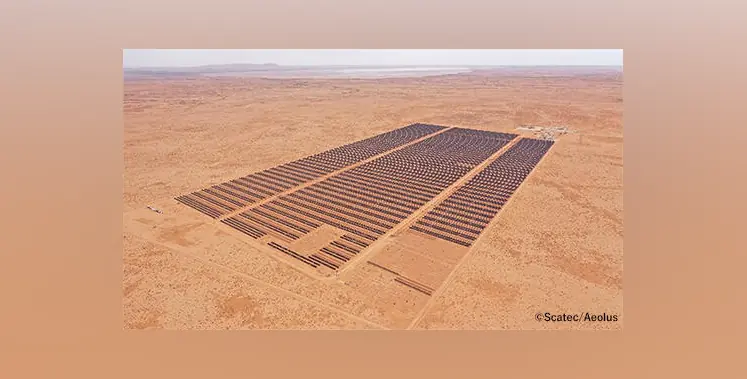
Toyota Tsusho launches two Tunisia solar plants, delivering 100MW clean energy to 120,000 homes nationwide. (Image source: Toyota Tsusho)