




vc.web.local

twitter Facebook Linkedin acp Contact Us

Energy

MENA solar wind power transition analysis

The report, Rise of Renewables in the Gulf Region, launched at the World Future Energy Summit, highlights that variable renewable energy capacity across the Middle East and North Africa is expected to increase by roughly ten times by 2040 and continue expanding through to 2060, even as the region maintains its role as a leading oil and gas producer

According to the analysis, renewables will play an increasingly central role in the region’s power system over the coming decades. By 2060, electricity is projected to account for around 35% of total energy demand in MENA, with the majority of this electricity generated from renewable sources. Solar and wind combined are expected to deliver about 85% of electricity generation by that point, with solar contributing approximately 45% and wind close to 40%.

“The rapid rise of renewables in the Gulf, and MENA more broadly, is not replacing hydrocarbons overnight, but it is reshaping the power system,” said Ditlev Engel, Energy Systems CEO at DNV.

“GCC countries are building some of the world’s largest solar and storage projects while still supplying global oil and gas markets. This development is driven mainly by economics. Renewables now provide low-cost electricity, and clean power is becoming necessary for competitive industry and future hydrogen production.”

DNV’s report explains that this growth is being propelled by a combination of expanding renewable supply and rising electricity demand. Utility-scale renewable projects are being rolled out across the region, including mega solar installations, hybrid solar-and-storage plants, and new wind farms. At the same time, electricity demand is increasing from data centres, electric transport, and green hydrogen production. Established industries are also shifting towards low-carbon electricity in response to policy measures such as the European Union’s Carbon Border Adjustment Mechanism.

A significant inflection point is expected around 2040, when annual increases in renewable electricity generation are forecast to outpace growth in overall electricity demand. This shift is projected to steadily lift the share of renewables within the regional power mix.

Solar energy remains the dominant renewable technology. Installed solar capacity is forecast to rise from 76GW in 2024 to 340GW by 2029, with solar expected to supply nearly 20% of total electricity by the end of the decade. An increasing proportion of these projects will incorporate battery storage to enable continuous power delivery and enhance grid flexibility.

Wind power, while currently less developed, is projected to triple in capacity each decade between 2020 and 2060. Its generation profile complements solar, producing more electricity at night and during specific seasonal periods, particularly when paired with storage solutions. Overall, DNV estimates that combined solar and wind generation in MENA will expand by around fourteen times by 2040, alongside a tenfold increase in installed capacity.

“The Gulf is moving from discussion to deployment,” remarked Jan Zschommler, market area manager for Middle East & Africa, Energy Systems at DNV.

“Utility-scale solar, wind, and storage projects are now being built at a pace that changes the regional power mix. Our modelling shows that renewables growth will exceed demand growth after 2040. That is when the transition in the region’s power mix starts to accelerate.”

Energy storage and system flexibility are identified as critical enablers of this transition. Storage capacity across the region is expected to surge from about 36GWh today to nearly 9,500GWh by 2060, with batteries increasingly taking over the role of thermal plants in providing short-term flexibility. Enhanced regional interconnections will further support grid stability and cross-border electricity trade.

These findings align with insights from DNV’s 2025 Energy Industry Insights survey, which shows that energy executives in the Middle East are the most optimistic globally about the sector’s outlook. Most respondents anticipate revenue and profit growth, citing the rapid expansion of renewables and associated infrastructure as key factors. The survey points to strong investment momentum, growing project pipelines, and confidence in the region’s long-term energy transition.

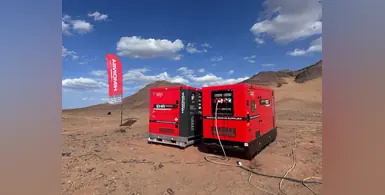
One of the new Africa range from Bobcat (Image source: Bobcat)

Bobcat has launched a new range of generators for the Africa market, providing a wider offering of over 20 models with prime power outputs from 20 to 1650 kVA

The new generators are designed for applications in construction, rental, general industry and agriculture, as well as home standby, telecommunications and back-up power for small and large businesses.

Designed and produced in the Middle East Africa (MEA) region, and intended for the region’s diverse, demanding environments, the new generators benefit from large air flows and robust components, providing a more cost-effective product for a market that is becoming much more competitive, according to Matus Gejdos, portable power product manager at Bobcat EMEA.

“The most popular generators in MEA are the 100, 200, 500 and 1000 kVA machines and the new range now fully covers these sizes,” said Gejdos.

The new range also boasts exceptional heat resistance and enhanced total cost of ownership.

As they are manufactured in the Middle East, this also results in shorter delivery times, with lower transportation costs and customs duties.

“The durability of the units has been demonstrated through extensive and successful testing in Middle East conditions for thousands of hours, with the units being used with different loads, and in temperatures above 40 °C,” said Gejdos.

The six smallest models in the range from 20-165 kVA — the PG20W, PG30W, PG50W, PG60W, PG110W and PG165W — are unchanged and feature proven Yanmar engines up to 60 kVA or Volvo engines, providing high uptime with a low requirement of repair and reduced noise levels.

The main change in the full array of generators is in the expansion of the model selection in the medium and marge sections of the range.

Bobcat has kept some of the previously used HD Infracore (HDI) engines which have been in the range for around 10 years now and are well proven products with excellent Bobcat support already established.

These engines are used in the medium sized PG220W and PG340W models and the large PG590W, PG710W and PG820W machines.

Complementing this, the company has created a new line of products with engines from Yuchai, one of the top two OEMs in China, which has been manufacturing for western brands for decades.

Whilst overlapping with the HDI line up of five models, the new product line has allowed Bobcat to offer more choice for customers, including much larger models, taking the product portfolio up to 1650 kVA (compared to the cap under the previous HDI range at 850 kVA).

Read more:

Geniwatt supplies on-site power for telecoms site

Industrial on-site power for Guinea metal factory

Sany powers Zimbabwe with reliable diesel generators


Scatec powering Africa's solar and renewables growth (Image source: Adobe Stock)

Norwegian renewables group Scatec ASA has signed a new power purchase agreement (PPA) in Egypt

The deal is with the Egyptian Electricity Transmission Company (EETC) for a total capacity of 1.95 GW solar and 3.9 GWh battery energy storage systems (BESS) in Egypt.

The combined capacity will be the largest solar and BESS installation in Africa and the largest investment in Scatec’s history.

Under the agreement, Scatec will deliver one integrated solar and BESS hybrid system designed to deliver continuous, around-the-clock renewable baseload power.

In addition, Scatec will develop two standalone BESS projects aimed at providing essential grid stability and support services.

Scatec will be compensated under a 25-year, USD-denominated pay-as-produced PPA, linked to the electricity generated by the hybrid system.

It did not disclose further details on capital expenditure, EPC scope and financing structure but added that this information is expected to be released in the latter half of 2026.

The plant is expected to deliver approximately 6,000 GWh of renewable energy annually.

Scatec is the lead developer of the projects and said it will also invite additional equity partners.

It will also provide engineering, procurement and construction (EPC), asset management (AM) and operations and maintenance (O&M) services for the projects. 

“Signing this groundbreaking PPA further cements Scatec’s leading position and commitment to delivering reliable, renewable energy at a large scale in Africa,” said Scatec CEO Terje Pilskog.

“By integrating advanced solar and battery technologies, we are providing Egypt with sustainable, around-the-clock power and grid stabilising services, supporting both the country’s energy transition and the region’s long-term economic development."

Read more:

Scatec's Kenhardt project earns global recognition

Scatec venture signs Liberia, Sierra Leone solar deals

Scatec pioneers industrial EV adoption on site in Northern Cape


Masdar PPA signing ceremony (Image source: Masdar)

Abu Dhabi Future Energy Company PJSC – Masdar has signed a power purchase agreement (PPA) for the 150MW Quipungo solar photovoltaic (PV) project in Angola
 
It marks the clean energy group’s debut PPA in the West African country.
 
The Quipungo project represents the first contracted site under Project Royal Sable, a planned 500MW renewable energy programme across three sites that will strengthen Angola’s southern power grid and support the country’s sustainable development objectives.
 
The agreement was signed with the state-owned offtaker Rede Nacional de Transporte de Electricidade (RNT-EP).
 
The PPA secures long-term electricity offtake from the 150MW Quipungo site, located in Huila Province in southern Angola.
 
By establishing the first commercial anchor project under Project Royal Sable, the agreement also provides a foundation for the phased development of the wider 500MW portfolio, which once completed is expected to create more than 2,000 jobs, deliver clean electricity to around 300,000 homes, and enhance power generation capacity in Angola’s southern grid.
 
Project Royal Sable reflects Masdar’s commitment to developing large-scale, bankable renewable energy infrastructure in emerging markets, supporting national energy strategies while expanding access to reliable, affordable clean power, according to its CEO Mohamed Jameel Al Ramahi.
 
“Africa is the world's fastest-growing continent and that growth will depend on affordable, secure energy,” he said.
 
“As a pioneer of renewables in Africa, Masdar is committed to developing clean energy across the region.”
 
He added that signing a first PPA in Angola represents an important milestone on its journey.
 
“The Quipungo PPA demonstrates how long-term partnerships and structured offtake arrangements can accelerate the deployment of utility scale renewables that support national clean energy ambitions, economic development, and job creation providing reliable, affordable clean power to local communities.”
 
Masdar is now the largest operator of renewables on the continent through its joint venture, Infinity Power, which currently operates 1.3 GW of solar and onshore wind power projects in South Africa, Egypt, and Senegal.
 
It also has a 13.8 GW project pipeline, including battery storage and green hydrogen facilities, in various stages of development.
 
The addition of Project Royal Sable will contribute to Masdar’s target of 100 GW portfolio capacity by 2030.
 
Also present at the signing ceremony was Francesco LaCamera, director general of the International Renewable Energy Agency (Irena).
 
“The Quipungo solar PV project will contribute to strengthening Angola’s power system and expanding access to clean, reliable electricity, improving thousands of lives and inspiring greater investor confidence in Africa’s energy transition,”said LaCamera.
 
Read more:


Totogi has been selected by an Africa-based MVNE to run 30 mobile brands and nearly one million subscribers on a single cloud-native charging platform

Totogi Today has revealed that an Africa-based mobile virtual network enabler (MVNE), supporting around one million subscribers across 30 mobile brands, has chosen Totogi Charging-as-a-Service to manage its entire multi-brand operation on a single cloud-native charging platform

The MVNE oversees a broad mix of prepaid, eSIM, broadband, and value-added mobile services for both consumer and enterprise offerings, all delivered through a unified infrastructure. By adopting Totogi’s pay-as-you-grow, price-per-transaction model, the operator aims to maintain tighter cost control, enable flexible scaling, and simplify the management of multiple brands through one multi-tenant charging environment.

Totogi’s multi-tenant platform introduces a new operating model for the MVNE. Each MVNO brand operates within its own dedicated tenant, with full autonomy to create tariffs, set pricing, and launch promotions, without relying on the MVNE for routine changes. This approach allows brand teams to move faster, while the MVNE retains overarching visibility and governance across the platform. The self-service capability removes much of the operational friction typically associated with supporting multiple MVNOs.

“Running multiple brands on one charging platform is the kind of operational complexity that would paralyse a legacy charging deployment,” said Danielle Rios, CEO of Totogi. “With Charging-as-a-Service on AWS, this MVNE gets elastic scale, instant pricing changes, and the ability to spin up new MVNOs, each with its own separate tenant, without spinning up new infrastructure. Each MVNO controls its own offers; the MVNE manages the platform. This is what modern charging looks like: one platform, 30 brands, a million subscribers, zero change requests.”

The deployment is currently in progress, with full implementation expected to be completed in early 2026.

More Articles …