




cc.web.local

twitter Facebook Linkedin acp Contact Us

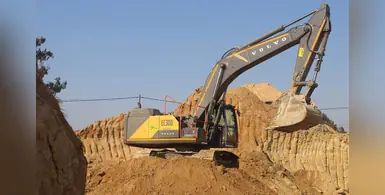
Zero-emission construction requires a coordinated ecosystem of solutions and seamless integration between machines, electrical infrastructure and energy management systems (Image source: Volvo CE/Hitachi Energy)

Volvo Construction Equipment (CE) and Hitachi Energy have announced a new pact to fast-track zero-emission construction sites

The move has broad potential impact across Africa and the rest of the globe as construction firms and equipment suppliers move toward cleaner, lower carbon working.

Two of the industry’s heavyweights have now signed a Memorandum of Understanding (MoU) that brings together the capabilities needed to make electric construction equipment a practical, on-site reality.

The collaboration brings together electric construction equipment with clean power supply, energy management and system integration capabilities to help address one of the construction industry’s most pressing challenges: decarbonisation.

Under the agreement, the two companies will work on a non-exclusive basis to assess potential technical and commercial concepts supporting zero-emission construction and manufacturing operations, with a focus on system integration and site-level operational execution.

The scope includes joint work on business models, go‑to‑market approaches, and aftermarket and support considerations, supported by joint teams from both companies.

“Strategic partnerships such as this with Hitachi Energy are key to accelerating the transition to zero-emission construction,” said Melker Jernberg, president of Volvo CE.

“By combining complementary expertise and delivering a complete, integrated solution, we are giving customers the confidence, security and peace of mind they need to adopt emission-free operations today.”

Customer and investor demand for lower‑emission, more productive construction operations is reshaping the industry, the two companies said in a statement.

At the same time, regulatory and permitting frameworks increasingly require projects to address emissions and environmental performance throughout the planning and approval process.

While electrification, automation and efficient resource and asset planning offer clear pathways to reduce emissions, transitioning from individual electric machines to fully functioning zero‑emission construction sites requires a coordinated ecosystem of solutions and effective system integration across equipment, power infrastructure, and energy management systems.

“Electrification is a game changer in the decarbonisation puzzle, particularly for hard‑to‑abate environments such as construction sites,” said Niklas Persson, CEO of Grid Integration at Hitachi Energy.

“As construction operations become more electric and more complex, success depends less on individual technologies and more on system‑level integration, strong execution, and close collaboration with partners like Volvo CE who share our ambition to enable zero‑emission construction at scale.”

The initial focus is on business and go‑to‑market‑oriented, emphasising practical, plug‑and‑play approaches to help customers simplify the transition to zero‑emission construction sites.

At the same time, the agreement establishes a foundation for deeper technical engagement over time, with the potential to explore more advanced capabilities such as connected machines, digital integration, and expanded service offerings.

Read more:

HMD, Tuboshu to launch for life scheme

Bankability will shape Africa's infrastructure future

BWH Hotels to focus on sub Saharan Africa in 2026 

Maintaining heavy equipment is a critical challenge for equipment owners

West African heavy equipment dealer, HMD Ghana Ltd., and partner brand Tuboshu are set to launch a new protection programme for machinery owners at the upcoming WAMPEX 2026 event

HMD is the authorised dealer across West Africa for Tuboshu heavy equipment.

Calling it a “new way to own and protect heavy equipment,” an HMD statement said the programme is intended to eliminate “the single greatest financial fear haunting every equipment owner” with full details to be released at the trade show.

“Alongside the live machinery display, HMD and Tuboshu will unveil For Life, a revolutionary protection programme set to change the economics of machine ownership,” the companies said in a pre-show media statement.

“For Life directly addresses the single greatest financial pain point facing every equipment owner, fleet manager, and contractor, regardless of sector, fleet size, or geography,” the statement added.

Activated upon request at the point of machine purchase and available across HMD's full Tuboshu portfolio, For Life will be demonstrated live at the HMD and Tuboshu stand throughout all three days of WAMPEX 2026.

The mining and power exhibition takes place from 3-5 June in Accra.

HMD called its new For Life solution “a genuine first” and that “no comparable solution exists anywhere in the African market today.”

It added: “We believe For Life will mark a turning point for how Africa's machinery sector operates — for miners, operators, fleet managers, and for the contractors who keep this continent moving.”

The two companies invited miners, equipment operators, fleet managers, project directors and dealers to find out more at the show.

They will occupy an indoor stand at Hall 1, Stand 1D13, and an outdoor display zone OS150 at the La Palm Royal Beach Hotel, with live Tuboshu machinery on display and a senior team available for meetings and briefings throughout all three days of the event.

HMD is a West African dealer of heavy machinery, genuine spare parts, machinery rental, rent-to-own solutions, and comprehensive after-sales services for the mining, construction, energy, and infrastructure sectors.

Tuboshu develops heavy machinery through partnerships with top-tier factories specialising in each product category, rather than relying on a single source.

Every machine is engineered for durability in demanding African conditions available for outright purchase, rental, or rent-to-own through HMD.

Read more:

Bankability will shape Africa's infrastructure future

Smart compressor designed for harsh conditions

Inzag strengthens Angola fleet with Liebherr crane


Aaron Chehab, head of strategy at Arabian Construction Company Group

Certainty before capital: why bankability will define Africa’s next growth phase, by Aaron Chehab, head of strategy at Arabian Construction Company Group

Africa’s long-term infrastructure outlook remains exceptionally strong with the continent seeing population growth, urbanisation, and industrial expansion. Additionally, the energy transition requirements continue to create significant demand across sectors. It is fair to say that the opportunity ahead is substantial.

The projects that will succeed over the next decade will likely share disciplined planning, credible governance, integrated delivery models and partners capable of bridging the gap between vision, financing, and execution.

However, funding is often seen as the primary challenge. More often, the real issue is creating enough certainty for capital to move with confidence.

At ACC, we recognised early that successful projects often form long before construction begins. That reality has pushed the business further upstream by supporting clients, governments and financing stakeholders during the initial structuring phases of projects.

Across the continent, ambitious projects continue to emerge. We see that urbanisation and long-term economic growth are driving forces behind the positioning of smart cities, logistics corridors, industrial hubs, transport infrastructure, and mixed-use developments. Many of these projects are rooted in genuine vision and national ambition.

Increasingly, this involves supporting stakeholders across areas such as technical feasibility studies, procurement planning, programme sequencing, construction methodology development, cost validation, environmental and social compliance alignment, and operational efficiency reviews.

Moreover, environmental and social governance has become another defining factor in this evolution. Alignment with International Finance Corporation Performance Standards and the Equator Principles is no longer considered optional for major projects seeking international financing. It is now a key part of lender confidence and the long-term viability of developments.

Projects that prioritise early-stage alignment across financing, procurement, environmental compliance, and execution readiness are in a much stronger position to attract institutional capital and move toward delivery with greater certainty.

The Ministerial City development in Benin is one example of this evolving approach.

Rather than relying solely on announcement-driven momentum, the project focused early on delivery fundamentals, including government alignment, financing pathways, procurement structures and execution readiness.

That level of preparation demonstrates a growing understanding across the market that successful infrastructure delivery is no longer just about building assets. It is about building confidence which ultimately unlocks capital.

We are witnessing investors and lenders operating in a far more disciplined environment. That is why capital deployment increasingly depends on delivery credibility, governance frameworks, environmental compliance, procurement clarity and long-term operational sustainability.

This shift reflects the continued development of Africa’s infrastructure landscape.

The continent is entering a phase where projects are being evaluated not only for their potential economic impact but also for their ability to withstand scrutiny from financiers, insurers, export credit agencies, and delivery partners.

In the long term, this shift is positive because it encourages stronger planning, better governance and more sustainable outcomes.

Read more:

Smart compressor designed for harsh conditions

INZAG strengthens fleet with Liebherr crane for Angola

New Africa hub boosts Metso port solutions 

X-Air 900-20 portable air compressor used in a blast hole drilling application. (Image source: Atlas Copco)

Atlas Copco has broadened its DrillAir range of portable air compressors with the introduction of the X-Air 900-20, developed to meet the rigorous drilling demands of industries across Africa, Australia and New Zealand, Central and South America, the Middle East and Southeast Asia

The new compressor has been designed to deliver operational flexibility, dependable performance and simplified usability for mining and construction applications operating in varied environments and job site conditions.

Drawing on Atlas Copco’s experience in portable compressed air technologies for heavy-duty operations, the X-Air 900-20 integrates advanced compressor controls, a compact structure and a durable build to provide reliable compressed air performance in challenging settings.

A major feature of the X-Air 900-20 is its PACE technology, enabling operators to adjust working pressure between 14 and 20 bar. This capability allows a single compressor to serve multiple drilling functions, helping businesses improve fleet efficiency while reducing the need for additional equipment onsite.

Within the mining sector, the compressor is intended for applications including blast hole drilling and dimension stone quarry drilling, where reliable airflow and operational adaptability are critical to maintaining productivity levels.

For construction activities, the unit supports operations such as slope anchoring, down-the-hole solar piling and ground engineering drilling. The adjustable pressure settings allow operators to tailor performance according to application requirements, improving efficiency while minimising fuel usage and component wear.

To support lower operational costs, the X-Air 900-20 incorporates ECO mode technology, which can reduce fuel consumption by up to 50% during unload conditions. By transitioning from idle to no-load operation, the compressor decreases unnecessary fuel burn, contributing to reduced ownership costs and improved component longevity. Fuel efficiency is also enhanced through FuelXpert technology, which continuously regulates fuel use during operation to maintain optimal performance and air delivery.

The compressor features the Xc2004 smart air controller, giving operators access to clear operational data, simplified machine controls and performance monitoring tools. The controller includes built-in alarms and protection systems to support safe and efficient operation in demanding environments. Integrated connectivity functions also provide users with transparent performance insights and operational analytics.

Built for durability, the X-Air 900-20 includes reinforced metal bodywork and a corrosion-resistant canopy designed to withstand harsh working environments. Its compact dimensions improve transportability and ease of deployment across different project sites.

Maintenance access has also been simplified through large service doors, a redesigned vessel layout and extended service intervals aimed at reducing downtime and maintenance effort. Integrated monitoring systems further assist with timely servicing and component protection.

Atlas Copco additionally offers optional packages for high-ambient, high-altitude and cold-climate operations, allowing customers to configure the compressor according to local site requirements and environmental conditions.

“The X-Air 900-20 is designed for customers who need a reliable, adaptable compressor that can support different drilling applications without added complexity. By combining flexible pressure, smart control, and a robust, easy-to-maintain design, we’re helping customers improve utilization and control operating costs across demanding job sites,” said Srijayan Iyer, product marketing manager for Large Air, Portable Air Division.

INZAG has taken delivery of a new Liebherr LTM 1090-4.2 mobile crane. (Image source: Liebherr)

INZAG has strengthened its equipment lineup with the addition of a new Liebherr LTM 1090-4.2 mobile crane

This four-axle unit enhances the capabilities of the globally active construction firm, offering a dependable and adaptable solution for complex tasks, particularly those linked to a major infrastructure development in southern Angola. The acquisition also reflects INZAG’s strategy of maintaining greater uniformity across its crane fleet. With this latest delivery, the company now operates two units of the 90-tonne model.

“Unlike crane hire companies, our aim is not to have the largest possible fleet with many different crane types, but rather a reliable all-rounder that is versatile and capable of handling both small and large lifts,” commented Lorenz Weber, procurement director at INZAG.

Beyond lifting performance, the company placed strong emphasis on safety and operational efficiency when selecting the crane. The four-axle configuration ensures excellent mobility while supporting cost-effective operations. Its adjustable axle load system enables smooth transportation across international routes and allows for flexible use on both highways and project sites. Additionally, integrated features such as ECOdrive and ECOmode contribute to lower fuel usage and reduced noise levels, supporting both operator comfort and environmental considerations.

First deployment in Angola requires flexibility

The crane’s first assignment will be in Angola, where INZAG is preparing for a major road infrastructure project. “With this new addition to our fleet, we are preparing for the start of a 146-kilometre road construction project in Angola,” explained Leandro Fernandez, managing director at INZAG.

The development focuses on upgrading the EN 140/295 national road, connecting the municipalities of Caiundo and Savate. Due to the remote nature of the site in southern Angola, relying on local crane rental services is not feasible.

“For this project, we needed a multifunctional crane that can be mobilised quickly, is flexible on site and can also be replaced during the operation – should that become necessary,” reported Weber.

The crane’s strong lifting performance and extended working radius made it particularly suited to the project’s demands.

“We will be using the new Liebherr crane primarily during the mobilisation phase, including for setting up camps and facilities, as well as for unloading and logistics tasks. It will also support operations at bitumen and precast plants, as well as the installation of box culverts,” remarked Fernandez.

Long-standing partnership and quality focus

INZAG continues to prioritise premium equipment and stringent quality standards across its operations. Many of its projects are supported by export financing from the German Federal Government, where the integration of German-engineered technology is a key requirement. The choice of Liebherr aligns with an established partnership between the two organisations.

“In addition to the machine itself, customer service, spare parts availability and technical support play a decisive role for us – requirements that Liebherr fulfils,” summarised Fernandez.

INZAG Germany GmbH specialises in delivering large-scale infrastructure developments across sub-Saharan Africa. Employing around 500 people, the company undertakes projects spanning road construction, water systems, energy infrastructure and port development. “We are currently active in Angola, Ghana and Uganda, among other places, combining European engineering expertise with extensive project experience in challenging markets,” said Weber. The company also provides export and trade services, facilitating connections between European OEMs and clients across Africa.

More Articles …