




vb

twitter Facebook Linkedin acp Contact Us

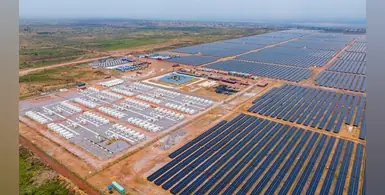
Lephalale solar plant powers Exxaro's greener mining. (Image source: Exxaro)

Exxaro Resources has reached a major milestone in its energy transition strategy with the commercial operation of the 68 MWac Lephalale Solar Project (LSP), its first utility-scale self-generation renewable energy facility

Developed through its wholly owned renewable energy business, Cennergi, the project reflects the growing shift among mining companies towards cleaner, more secure power sources as rising electricity costs, grid constraints and decarbonisation targets reshape the sector.

Located adjacent to Exxaro's Grootegeluk Mine in Limpopo, the behind-the-meter solar photovoltaic (PV) plant comprises 129,024 solar modules installed across 185 hectares. Unlike grid-scale solar farms that primarily supply electricity to national utilities, behind-the-meter facilities generate power directly for industrial operations, reducing dependence on the public grid while improving operational reliability. The plant is expected to generate approximately 176 GWh of renewable electricity annually, supplying daytime power to the mine under a 25-year power purchase agreement.

The project achieved Commercial Operations Date (COD) on 20 April 2026, following financial close in June 2023, construction beginning in August 2023, first power delivery in December 2025 and full generation capacity reached later that month. With an investment of R1.7bn (approx. US$104mn), the project demonstrates Exxaro's ability to develop, finance, construct and operate large-scale renewable energy assets while strengthening energy resilience for its mining operations.

Mining companies across Southern Africa are increasingly investing in captive renewable energy as they seek to reduce exposure to power shortages, volatile electricity tariffs and carbon-related costs. South Africa's ongoing electricity supply challenges, combined with corporate net-zero commitments and supportive regulatory reforms for private generation, have accelerated renewable energy deployment across the mining sector. Solar PV has become one of the fastest-growing technologies due to its relatively short construction period, predictable operating costs and ability to offset daytime energy demand.

The Lephalale Solar Project is designed to reduce Exxaro's Scope 2 greenhouse gas emissions by approximately 17%, while lowering electricity costs for Grootegeluk Mine by more than R100m (approx. US$6.1mn) annually. The facility has also been licensed for future integration with a Battery Energy Storage System (BESS), allowing excess solar generation to be stored and dispatched when required. This future capability will improve energy flexibility and help maintain operations beyond daylight hours as storage technologies become increasingly economical.

Speaking at the official opening, Exxaro CEO Ben Magara said the project marks an important step in delivering the company's Sustainable Growth and Impact strategy.

"The official opening of the Lephalale Solar Project is far more than the completion of a renewable energy facility; it marks another significant milestone in the delivery of our sustainable growth and impact strategy," he said.

"The project demonstrates our ability to successfully develop, finance, construct and operate large-scale renewable energy infrastructure through our growing renewable energy business, Cennergi."

Beyond reducing emissions, the project is expected to strengthen Exxaro's long-term operational resilience by providing greater energy security, reducing exposure to carbon taxes and supporting more predictable electricity costs.

The project has also delivered measurable socio-economic benefits during construction. It created 808 jobs, of which 557 positions (69%) were filled by members of local host communities, including three people living with disabilities. Local procurement accounted for 41.9% of project spending, benefiting 13 local subcontractors and supporting regional economic development.

To support a just energy transition, Exxaro invested R1.12m (approx. US$68,400) in community bursaries and workforce development programmes, providing training in photovoltaic installation, firefighting, first aid, incident investigation and other construction-related skills that will remain valuable beyond the project itself.

The successful delivery of the Lephalale Solar Project strengthens Cennergi's renewable energy portfolio and provides a scalable model for future industrial renewable energy developments. As mining companies continue balancing productivity with sustainability, self-generation projects such as Lephalale are expected to play an increasingly important role in reducing emissions while improving operational efficiency and long-term competitiveness.

Smelter operations at Kamoa-Kakula (Image source: Ivanhoe Mines)

Ivanhoe Mines said its Kamoa-Kakula on-site solar facility with battery storage is set to ramp up to full capacity during Q3 2026 — with plans well advanced to double on-site solar capacity to 120 MW by the end of 2027

In a Q2 update, the company reported that commissioning of Kamoa-Kakula’s on-site solar photovoltaic (PV) facilities in the Democratic Republic of Congo (DRC) are underway, as part of efforts to drive down energy costs and expand mining output.

Once fully ramped up during the third quarter, the facilities will deliver 60 MW of continuous baseload power to Kamoa Copper as its sole offtaker, it noted.

The solar and battery storage facilities are owned, operated and funded by CrossBoundary Energy and Green World Energie.

The two facilities have a combined 433 MW of peak installed solar PV capacity and 1,107 megawatt-hours (MWh) of battery energy storage system (BESS) capacity.

The facility is the largest hybrid solar PV and BESS facility installed by a mining company in Africa.

Looking ahead, Kamoa-Kakula is also advancing plans to double on-site solar power capacity, with battery storage, up to 120 MW by the end of 2027.

During Q2, a tender was awarded and a power purchase agreement (PPA) signed with Green World Energie for an additional 30 MW on-site hybrid solar PV facility with BESS.

Construction is expected to be completed in Q3 2027, Ivanhoe Mines said in its update.

A further 30 MW solar PV facility is currently undergoing final contract negotiation and is expected to be awarded soon, it added.

As well as work at the Kamoa-Kakula complex, Ivanhoe Mines is also looking to upgrade energy facilities at the ultra-high-grade Kipushi zinc-copper-germanium-silver mine, also in the DRC.

The company is expected to releasemore details when it publishes its Q2 2026 financial results at the end of July.

Read more:

Nesa Power gets cash boost for C&I power growth

Gensets to boost Algeria's powdered milk production

Nestle sites gain nearly seven megawatts of solar


AFC reaches financial close on 119MW power plant, Burkina Faso's largest, to help close its electricity access gap (Image source: AFC)

A major power project in Burkina Faso is to proceed after securing a first US$60mn tranche of a US$300mn corporate loan facility from Africa Finance Corporation (AFC)

The funds will support the development of the 119MW thermal power plant by Aksa Enerji Üretim A.Ş., Türkiye’s largest publicly-listed power generation company.

The project is expected to make a huge dent in accss to electricity in Burkina Faso, a country of 24 million people where only one in five currently have access to power.

“Burkina Faso represents an important milestone in our long-term commitment to Africa,” said Cemil Kazanci, chairman of Aksa Enerji.

“Together with AFC, we are delivering critical energy infrastructure that will strengthen energy security, support economic development and improve the reliability of electricity supply for millions.”

The transaction marks AFC’s first investment in Burkina Faso, but builds on its US$150mn corporate loan facility to Aksa Enerji in 2025, which supported the company’s utility-scale gas-to-power projects in Senegal and Ghana.

This includes Senega’s new 255MW combined-cycle gas power plant designed to use domestic natural gas to deliver more reliable and lower-emission baseload power.

Collectively, these projects have established Aksa as a major partner in delivering large-scale energy infrastructure across Africa.

The Burkina Faso project is expected to transform the nation’s electricity system.

The West African state currently imports 60% of its power supply, leaving homes, businesses and industry vulnerable to supply disruptions and elevated energy costs, constraining industrialisation and economic growth.

Once operational in 2027, the power station will reduce dependence on imported electricity by more than 50% while significantly strengthening domestic generation capacity.

By delivering more reliable, lower-cost baseload power, the project is expected to improve energy security, attract private investment and create a stronger foundation for long-term economic growth, according to the AFC.

Expanding reliable electricity access is a central part of the Corporation’s mission in unlocking sustainable growth across the continent.

“Africa’s path to industrialisation and global competitiveness by 2050 depends on the infrastructure decisions we make today,” said Samaila Zubairu, AFC’s president and CEO.

“Reliable electricity is fundamental to economic transformation. Without dependable power, countries cannot industrialise, businesses cannot grow and communities cannot realise their full economic potential. Aksa shares our commitment to delivering the reliable energy infrastructure needed to power Africa’s industrial growth and long-term transformation.”

Read more:

Nesa Power gets cash boost for C&I power growth

Gensets to boost Algeria's powdered milk production

Nestle sites gain nearly seven megawatts of solar

Egypt advances clean energy with strategic infrastructure investment

The Emerging Africa & Asia Infrastructure Fund (EAAIF), a Private Infrastructure Development Group (PIDG) company managed by Ninety One, has committed a US$30mn senior secured corporate loan to Hassan Allam Utilities to support the development of the Minya 1,000MW solar photovoltaic project and 660MWh battery energy storage system (BESS) in Egypt

The financing will primarily support the flagship renewable energy project, which combines utility-scale solar generation with battery storage to strengthen grid stability while delivering reliable and affordable electricity to businesses and communities.

The Minya project is being co-developed by Hassan Allam Utilities and Infinity Power, the renewable energy joint venture between the UAE's Masdar and Egypt's Infinity. Once completed, it is expected to rank among the largest standalone solar developments in Africa.

The latest financing expands the partnership between EAAIF and Hassan Allam Utilities following a previous US$40mn facility agreed in November 2024 to support a pipeline of renewable energy developments, including the 1,100MW Suez Wind Project, which is being co-developed with ACWA Power. Together, the investments highlight EAAIF's continued role in mobilising private capital for large-scale infrastructure supporting Egypt's low-carbon transition.

Egypt continues to increase investment in renewable energy as electricity demand grows and energy security becomes an increasingly important priority. Although fossil fuels currently account for around 89% of the country's electricity generation, the government's Integrated Sustainable Energy Strategy 2035 targets renewables contributing 42% of the national power mix by 2030.

The transaction also represents an important step in EAAIF's expansion across the Middle East, North Africa and Asia. Acting as the sole lender with a primary claim in the financing, the fund is supporting local project developers while helping de-risk strategic renewable energy infrastructure in one of the region's fastest-growing clean energy markets.

The investment also aligns with PIDG's broader strategy of advancing climate-resilient infrastructure through innovative financing solutions. By supporting greenfield renewable energy projects in Egypt, EAAIF aims to accelerate private sector investment while contributing to sustainable infrastructure development across Africa and Asia.

Martijn Proos, Co-Head of Emerging Market Alternative Credit, Ninety One, the fund manager of EAAIF said: "The expansion of our partnership with Hassan Allam Utilities supports Egypt’s transition to localised renewable power. Scaling innovative financing structures alongside battery storage infrastructure strengthens grid stability and underpins sustainable growth. This transaction also provides a model for other EMDEs seeking to decarbonise while creating high-quality green jobs."

South Africa set for C&I power boost (Image source: Adobe Stock)

Nesa Power, a South African commercial and industrial (C&I) renewable energy group has secured R150mn in mezzanine debt funding from Maia Capital Partners

The money will be used by Nesa as growth capital to fund the acquisition of solar photovoltaic (PV) sites and expand its portfolio.

The company delivers integrated solar, storage and energy solutions under long-term power purchase agreements (PPAs) for clients in South Africa and beyond.

Since its inception, Nesa Power and its founders have built over 46 megawatt-peak (MWp) of solar PV generation capacity and 6.5 megawatt-hours (MWh) of battery storage, and has raised over R400mn in capital in managed funds that have invested in and currently operate over 70 solar PV C&I assets on a PPA basis.

The company is committed to providing renewable energy solutions that drive savings, ensure uninterrupted operations and reduce businesses’ carbon footprints by offering tailored renewable solutions, including on-site and off-site generation and storage.

“Securing this mezzanine facility from Maia Capital is a significant milestone for the group and reflects the strength of the business we have built,” said Mike Bleyenheuft, co-founder and CEO of Nesa Power.

He said the partnership with Maia Capital will ensure that Nesa Power continues to deliver innovative, high-quality renewable energy solutions to the C&I market.

“The energy transition in South Africa is accelerating, and with the private renewable market on a trajectory to surpass R200bn by 2030, the opportunity ahead of us is substantial. We look forward to leveraging this partnership… to drive our next chapter of growth.”

Nesa Power has built and operated C&I renewable energy assets through strategic investment partnerships and managed funds for more than a decade and has now evolved into an integrated renewable services group providing the C&I market with turnkey renewable energy services.

Through its group companies, it offers the market greenfield development, in-house design, engineering, procurement and construction management (EPCM), PPA funding, ownership and maintenance (O&M) services as well as carbon credit development services where the group has one of the first solar-based VERRA carbon grouped projects in South Africa.

Nesa Power’s co-founder and group chief investment officer, Percy Ying, said the new investment “materially strengthens” the company’s ability to execute on its growth strategy.

“The investment will also facilitate meaningful job creation and contribute positively to the broader South African economy — an outcome we are deeply committed to."

Read more

Gensets to boost Algeria's powdered milk production

Nestle sites gain nearly seven megawatts of solar

GE Vernova drives Africa's industrialisation with integrated power 

More Articles …