







Africa’s ports are facing increasing pressure as infrastructure is required to support larger vessels and growing demand
At the same time, these assets must perform within dynamic coastal environments, increasingly influenced by climate change. The future of the continent’s maritime infrastructure will depend on how well engineering, environmental understanding, and system-level thinking come together.
For Yasmin Kistner, principal associate: maritime, discipline lead: ports, WSP in Africa, the challenge begins with the physical reality of ports.
“Future-ready infrastructure means providing deeper, more robust facilities to accommodate increasing vessel sizes and cargo demand, while also responding to changing climate systems,” she explains.
Yet in South Africa, this is not a blank-slate exercise. Much of the country’s port infrastructure already exists, and that changes the nature of the problem.
“The challenge is working with what is currently there and improving it to make it future-proof, while continuing operations at the same time,” Kistner says. “You cannot simply deepen a channel or expand a basin without considering how that affects the stability of the existing infrastructure. Every intervention has knock-on effects.”
Balancing act
This tension between immediate functionality and long-term resilience plays out in every upgrade, where engineering decisions must balance operational continuity with structural integrity and future capacity.
Ports, however, do not operate in isolation. Their performance depends not only on the infrastructure itself, but on how efficiently cargo moves through the broader logistics system and how the port functions within its coastal environment over time.
“Seaports are critical for connecting South Africa to global trade, but inland dry ports are becoming an increasingly important part of how goods move inland,” says Kistner. “They allow cargo to be stored and distributed away from congested port environments, improving efficiency and reducing pressure on coastal infrastructure.”
As these systems become more interconnected, design must respond not only to operational demands and the capacity of hinterland networks to handle logistics flows, but also to how infrastructure performs within its coastal context over the long-term.
A coastal understanding
For Samantha Fourie, coastal modeller: maritime, WSP in Africa, numerical modelling of coastal processes provides the foundation for understanding how these environments behave before infrastructure is introduced or altered.
“Every project starts with a question, but before you can answer it, you need to understand the current environment,” she explains. “We build what we call a baseline. That means collecting data, measurements, and observations so we can quantify what is happening now before predicting what will change.”
This baseline is fundamental. It is what gives clients, regulators, and stakeholders confidence that decisions are grounded in reality.
“Data is everything,” Fourie says. “Without it, you cannot validate your model or your conclusions. Whether you are looking at coastal erosion, wave behaviour, or water quality, you need to understand the processes at play before you can assess the impact of any intervention.”
A deeper understanding
In practice, this means building detailed environmental models that simulate how coastlines, currents, and infrastructure interact under different scenarios, including long-term change.
“The outputs feed directly into decision-making,” Fourie says. “It comes down to risk, safety, environmental impact, and regulatory requirements. The work does not sit in isolation. It influences whether something gets built, how it gets built, and what safeguards need to be in place.”
The intersection between these two perspectives is where the future of port development is being shaped.
Port and coastal engineering has always considered and will always consider the dynamic coastal environment. The aspect requiring increased consideration is having a thorough understanding of potential long-term changes in the coastal and logistics environment.
Environmental considerations
From a design perspective, Kistner points to incremental yet meaningful shifts already underway.
“We are investigating the use of more environmentally friendly materials, such as alternative concretes in breakwater structures, and designing for future energy systems like shore power,” Kistner says. “This allows vessels to draw electricity while docked, reducing emissions and improving air quality in port cities.”
But sustainability is not limited to materials or energy systems. It is embedded in how infrastructure responds to long-term environmental change.
“Climate change is going to impact coastlines regardless of how we build,” says Fourie. “The role of modelling and engineering is to help infrastructure adapt to those changes, not just respond after the fact.”
Integrated thinking
Looking ahead, Kistner and Fourie both see a shift toward more integrated, system-level planning.
“There is a growing awareness that numerical modelling of coastal processes and engineering need to work more closely together,” Fourie adds. “You need predictive tools to design infrastructure that can adapt over time.”
This integrated approach is already shaping long-term planning at a national and regional level. “Across Africa, many established ports are already undergoing phased expansions and upgrades to accommodate increasing demand and evolving vessel requirements,” says Kistner.
These projects are not only about adding capacity at the coastline. They are increasingly part of wider efforts to improve the movement of cargo across the full logistics network. This includes investment in rail and road corridors, as well as the development of inland terminals and dry ports that can support more efficient distribution.
By moving some activity away from constrained coastal environments, these interventions can help relieve pressure on ports while improving the reliability of trade flows between coastal gateways and inland markets.
Together, these developments point to a broader reality: ports are no longer standalone assets. They are critical nodes in a connected system of trade, infrastructure, and environmental dynamics.
Africa’s maritime future will depend on how well that system is understood, planned, and managed. “We are not just building for today,” Kistner says. “We are building infrastructure that must remain functional and resilient decades into the future.”
For Fourie, that future carries a more personal dimension. “It becomes quite personal when you think about it,” she says. “You want to protect coastlines, support sustainable development, and ensure that future generations can experience these environments in the same way we have.”
There is no single solution. The path forward lies in combining sound engineering with a clear understanding of environmental processes, while supporting efficient and sustainable port operations. “In a system with a limited tolerance for error, that level of integration is essential,” concludes Kistner.
Read more:
DP World launches Egypt's first integrated logistics centre
Africa's ports: anchoring a resilient future
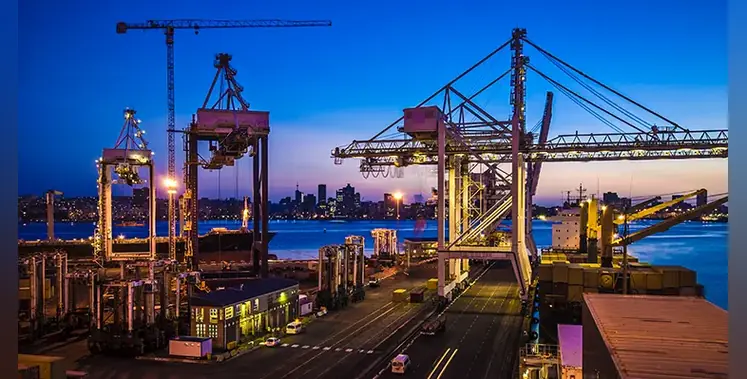
Navigating in a new era for Africa's ports (Image source: Adobe Stock)