







Implementing Proximity Detection Systems (PDS) in underground mining environments involves far more than installing sensors on equipment. The effectiveness of these systems depends on a combination of factors, including restricted working spaces, diverse equipment fleets, communication limitations and human behaviour
Booyco Electronics is addressing these complexities by focusing on system integration, data collection and the practical application of artificial intelligence (AI).
One of the key challenges facing underground mines is ensuring seamless integration between PDS solutions and equipment from multiple original equipment manufacturers (OEMs), as well as third-party interface providers. Although the ISO 21815 standard provides guidance on system interactions, real-world implementation can vary significantly.
Anton Lourens, CEO of Booyco Electronics, explained, “Some of the challenges we see are integration with OEMs as well as third-party interface suppliers. Even though there is a standard which guides how we need to interact, there still seems to be a difference of interpretation of the standard.”
This means that introducing a new vehicle type or equipment model can often require a new integration process. According to Lourens, each new machine configuration presents its own technical considerations.
“Every time a customer buys a new machine type or opts for a different OEM, that first time integration of PDS can be challenging,” Lourens pointed out.
The process can become even more demanding when customers inform Booyco Electronics late in the procurement cycle that newly purchased equipment requires immediate PDS installation. To address this, the company is expanding its library of OEM integrations while encouraging customers to engage earlier during equipment selection and procurement stages.
Turning mining data into actionable insights
For Booyco Electronics, PDS technology serves not only as a safety mechanism but also as a valuable data platform. Every interaction, near miss and system activation generates information that can support improved training, risk management and operational decision-making.
This data-driven approach also extends to analysing equipment performance and identifying potential risk areas within mine environments.
“From data analysis, you can see which vehicles have been involved in more interactions versus people, so you can identify higher potential risk assets,” stated Lourens.
By expanding location-based infrastructure and mapping underground activity, Booyco Electronics enables mines to identify areas with increased risk exposure. These insights can help operators introduce additional engineering measures or improve procedures where required.
AI supports, but does not replace, human expertise
As artificial intelligence becomes increasingly influential across industries, Booyco Electronics is taking a measured approach to its implementation within PDS solutions. Lourens emphasises that AI should be viewed as an enhancement tool rather than a replacement for human expertise and engineering principles.
“There are misinterpretations or misperception in terms of AI and what it can or can't do. Probably most known for deployment around AI cameras, the technology has evolved significantly with far more powerful capabilities in running algorithms, simulations, predicting behaviour through machine learning and ultimately the ability to process high volume of data in a very short space of time; ultimately still requiring human review and oversight. In addition, specific AI models are being developed or implemented for a specific problem statement, rather than a general AI assistant,” commented Lourens.
Within the PDS environment, AI can improve the speed and accuracy of data processing, strengthen pattern recognition, support behaviour prediction and convert large volumes of operational data into meaningful insights.
However, Lourens stresses that AI cannot replace the engineering foundations required for effective safety solutions.
“AI now is evolving rapidly, and becoming more important as it helps and assists in development and improvement but, honestly, I don't believe that today AI models can replace human responsibility in technology development. It is another tool to improve the product,” he explained.
Booyco Electronics views PDS and AI-enabled analytics as part of a broader, layered safety strategy. This approach combines engineering controls, risk assessments, operational optimisation and workforce training to create stronger safety outcomes.
By integrating reliable system connectivity, advanced data acquisition capabilities and a practical approach to AI adoption, Booyco Electronics is helping mining operations overcome the challenges of underground PDS implementation and move closer towards achieving the goal of Zero Harm.
Underground mines adopt smarter safety solutions
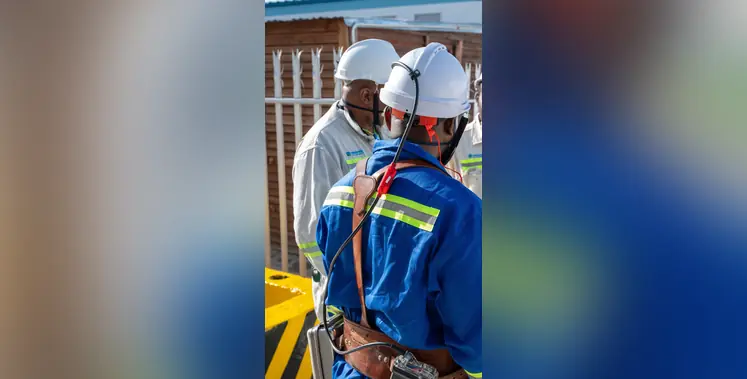
Effective PDS implementation depends on reliable integration and an understanding of underground mining conditions. (Image source: Booyco Electronics)