







As mining companies across Africa intensify their digital transformation efforts, dependable wireless connectivity is emerging as a critical requirement for enabling real-time operations, telemetry and safer, more productive mining environments
In response to these demands, Tharisa Minerals and Datacentrix have partnered to deploy Africa’s first RADWIN FiberinMotion wireless network solution, establishing a scalable digital platform for connected mining operations.
The deployment has transformed Tharisa Minerals’ open-pit mining operation in South Africa into a more connected and data-driven environment. Tharisa, an integrated resource group supporting the global energy transition and decarbonisation agenda, operates the Tharisa Mine in South Africa’s North West province. The open-pit platinum group metals (PGM) and chrome mine is situated on the western limb of the Bushveld Complex, an area containing more than 70% of the world’s platinum and chrome resources.
The project began when Tharisa’s chief information officer, Paul Collins, approached Datacentrix to address a growing operational challenge faced by many modern mining companies: maintaining reliable wireless connectivity across an open-pit mine with constantly changing terrain and infrastructure layouts.
Previously, the operation relied largely on conventional 3G connectivity through SIM-enabled fleet vehicles. However, this setup was insufficient to support the company’s long-term strategy of enabling “Connected Machines and Connected People”, where operational data from mining equipment, systems and personnel can move seamlessly across the site in real time. Reliable connectivity is essential for applications such as fleet management, telemetry and safety monitoring across haul trucks, drill rigs and excavators.
“From our perspective, the driver wasn’t the technology itself, but the operational use case,” said Collins. “We needed to ensure that our maintenance teams in the pit could remain connected at all times. Without reliable connectivity, their mobility and efficiency were limited.”
The changing conditions within an open-pit mine created additional challenges for maintaining stable wireless coverage. As benches shift and haul roads evolve, line-of-sight conditions frequently change, often creating coverage gaps across the operation.
“The simplest way to describe it is that the hotspots are always moving,” Collins explained. “You don’t want to constantly rebuild your network infrastructure to accommodate this. It needs to adapt automatically as the operational environment evolves.”
Alternative technologies, including private LTE, 5G and mesh networks, were evaluated but did not meet the mine’s operational requirements due to concerns around complexity, adaptability and cost efficiency.
“We did consider LTE and 5G, but the cost simply didn’t justify the value for our use case,” Collins noted. “We’re a low-cost producer, so we actively look for solutions that support this strategy.”
“The key consideration was finding an alternative to LTE and 5G that could deliver similar functionality, but without the associated cost and complexity,” said Gys Malan, Solutions Architect at Datacentrix. “Tharisa also needed something easy to manage, without the overhead typically associated with traditional mesh networks.”
To address these challenges, the two companies selected RADWIN’s FiberinMotion technology, which offers low-latency, high-throughput wireless connectivity capable of supporting mobility in demanding mining environments.
Before full implementation, Tharisa and Datacentrix conducted a proof of concept (POC) within a live mining environment to validate the system’s performance. The POC combined fixed high sites for point-to-point and point-to-multipoint connectivity with two temporary six-metre mobile towers designed to simulate trailer-mounted high sites.
Testing was carried out across several fleet assets, including excavators, dump trucks and light-duty vehicles, to evaluate roaming performance, network stability and handover capabilities.
“The POC phase involved multiple iterations, with repeated testing and validation under real-world conditions until we were confident in the solution and the results were very encouraging,” said Collins. “We achieved broad coverage, and even where there were minor gaps, they aligned with our expectations based on tower positioning. It gave us confidence that we could meet our operational requirements.”
Following the successful trial phase, Datacentrix implemented the permanent network infrastructure, which included ruggedised trailer-mounted towers capable of moving alongside the evolving mine pit. The system has now been operating successfully for approximately a year.
“The key outcome for us was enabling telemetry across our fleet and improving visibility into performance,” Collins said. “We can now stream data, monitor operations and even support video feeds from equipment like excavators. That simply wasn’t possible before.”
Beyond productivity improvements, the platform has also strengthened operational safety through enhanced fleet visibility and monitoring.
“For example, we can track behaviours such as unsafe machine operation, enabling better operational control and contributing to safer working conditions,” Collins said.
The deployment has also created a long-term digital foundation capable of supporting both critical and non-critical operational traffic across the mining environment.
“We now have a network backbone that can support both critical and non-critical traffic, which is something we didn’t have before,” said Collins. “There’s still a maturity journey ahead in terms of optimisation, but the platform is stable and performing well.”
Malan noted that the solution also offers a lower total cost of ownership because the infrastructure can be fully managed internally without relying heavily on third-party providers. “This is different to an LTE environment, for example, which often would require external dependencies.”
The Tharisa Mine project marks the first deployment of RADWIN’s FiberinMotion technology in Africa, positioning the operation among the continent’s leading examples of connected mining innovation. Additional deployments are already underway elsewhere in the region.
“What started as a challenge to achieve reliable connectivity has become a long-term proven platform strategy for us,” Collins said. “We now know that we’ve invested in something that is not only effective today, but reusable across the group and scalable for the future.”
Tharisa is now extending the same technology to its Karo Platinum operation in Zimbabwe, a low-cost open-pit PGM asset located along the Great Dyke.
“The Tharisa deployment was the first in Africa, and a second is now in progress at Karo Mining in Zimbabwe,” he said. “The Zimbabwe rollout will cover a significantly larger operational footprint, further demonstrating the scalability of the solution in complex mining environments.”
Collins added that the ability to remotely deploy and manage the infrastructure has proven particularly valuable for expanding operations across multiple regions. “We now have enough confidence in the platform to roll it out in another country without needing a team on-site within close proximity. That’s a critical factor for us.”
He also highlighted Datacentrix’s contribution to the project’s success. “It comes down to trust and responsiveness. If I can pick up the phone and get support when I need it, that makes a big difference,” he said. “Datacentrix understands both the technology and the mining industry, which means we can align quickly and move forward without unnecessary complexity.”
“The RADWIN FiberinMotion solution has subsequently been adopted by several other local mining organisations, with the assistance of Datacentrix, reinforcing its ability to enable safe, scalable and cost-effective digital transformation across the full mining lifecycle,” Malan said.
Tharisa advances connected mining operations
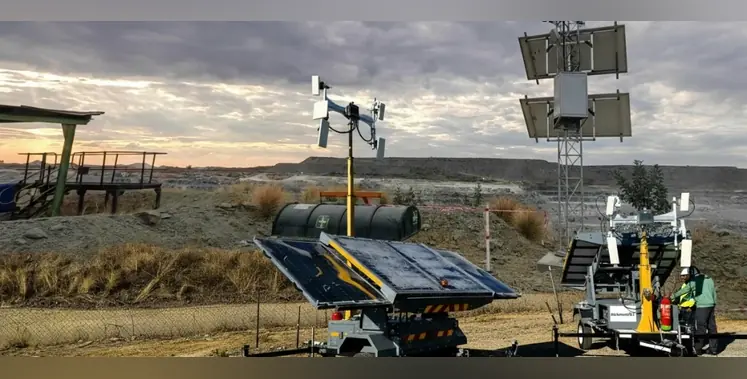
Tharisa Minerals and Datacentrix deploy Africa’s first RADWIN FiberinMotion solution for connected mining operations. (Image source: Tharisa)