Growing sales of Pilot Crushtec’s BFH1000 belt feed hopper and GFH560 grizzly feed hopper point to changing priorities among customers investing in materials handling equipment
Wayne Warren, Africa sales manager at Pilot Crushtec, attributes the increased demand to a preference for established equipment designs that are readily available, alongside solutions that can be configured to meet specific operational requirements.
“Customers are realising that, when correctly specified for their duty, the right feed hoppers are capable of improving the performance of the entire processing plant,” Warren stated. “This is what Pilot Crushtec’s established modular feeder range can offer and growing demand shows that it is what the market values.”
While the company's feed hoppers are available off-the-shelf in a selection of established configurations, their adaptable base units also allow customers to tailor equipment to different applications. Warren points to the BFH1000 and GFH560 as examples of this approach.
“Both these units are designed to provide surge capacity and a controlled feed into downstream equipment, but the GFH560 incorporates a heavy-duty tipping grizzly to scalp oversize material before it reaches the crusher,” he explained. “Its specification allows throughput of 30-200 tonnes per hour, with feed sizes up to 150 mm depending on material – while the BFH1000 offers up to 500 tonnes per hour and can accommodate feed material up to 300 mm.”
The BFH1000 is equipped with a 14 m³ heaped hopper, a variable-speed belt and a 15 kW drive. An optional hopper extension increases its capacity from 14 m³ to almost 20 m³.
The GFH560 features a standard 3.6 m³ hopper, which can be expanded to approximately 6 m³ with an optional extension. Its 650 mm variable-speed belt enables operators to adjust material delivery according to plant requirements.
Warren notes that feeder selection needs to account for the wider processing application, rather than being determined solely by the crusher receiving the material.
“Other important factors to consider are the feed size, feed volume, storage volume, abrasiveness of material, and moisture content,” he says.
Maintaining a consistent supply of material is another important consideration, as fluctuations in loading can affect the performance of downstream machinery. Feed hoppers provide a buffer between loading operations and processing equipment, helping maintain a controlled flow to crushers and screens.
“This can improve production consistency, maximise available power and promote more even wear,” he said.
The GFH560 also performs a scalping function, separating material larger than 100 mm before it enters the crushing stage. This combines oversize removal with the hopper's surge capacity and controlled discharge.
Modular design supports changing production requirements
Beyond their feeding capabilities, the modular construction of Pilot Crushtec's equipment offers flexibility in installation and plant configuration. The skid-mounted units can be positioned on a level, compact surface, reducing the need for extensive civil works.
Their standardised design also allows operators to relocate equipment or modify configurations as processing demands evolve. The units are designed for rapid installation and integration into the Pilot Modular system.
“This adaptability is increasingly relevant to customers looking to add capacity, or to process previously uneconomic material,” he says. “It also helps when they want to modify an existing plant but need to be conservative with their capital outlay.”
A project in Zambia demonstrates how this flexibility can be applied in practice. A Pilot Modular cone crusher was moved to another section of the operation and subsequently integrated with a GFH560 to serve a new processing application.
Modular feeders bring greater flexibility to crushing operations
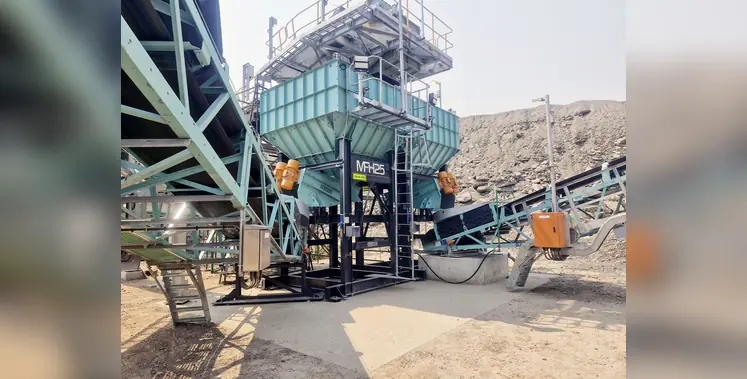
Pilot Modular feeders offer flexible configuration options to accommodate a broad range of applications. (Image source: Pilot Crushtec)