Increasingly stringent health and safety requirements across African mines are placing greater emphasis on the environmental conditions in which mobile equipment operates.
This makes ambient temperature a critical factor when selecting and specifying heating, ventilation and air conditioning (HVAC) systems for mining machinery.
Brenton Spies, managing director of Johannesburg-based Booyco Engineering, cautions that a system's stated cooling capacity may not reflect the performance it can deliver in the field, particularly in mining regions exposed to extreme heat.
"A cooling system that delivers its stated capacity under relatively mild conditions will perform very differently when exposed to the extreme ambient temperatures encountered in parts of Africa," commented Spies. "A 9 kW system operating in an environment that regularly experiences 46 degree heat, for instance, has a very different output in 29 degree surroundings; it is just not the same cooling capacity."
He notes that the same principle applies to other demanding sectors, including military applications, where equipment cooling must be designed around the environmental conditions it will face during operation.
For mining machinery, the draw-down period is another important specification. This refers to the time needed to reduce the temperature inside a hot operator cab to a comfortable level. If cooling takes too long, large machines may remain idling while operators wait for the cab temperature to fall, affecting equipment availability and operating costs.
"A correctly specified unit should take the temperature from 46 degrees to a comfortable temperature within about 20 minutes," stated Spies. "If the specification of the unit has not taken ambient conditions into account properly, the mine could end up idling a large diesel engine for significantly longer to cool down the cab - counting the cost in diesel and standing time."
Beyond temperature, mining HVAC systems must be engineered to cope with dust, vibration, extended operating hours and restricted installation space. These demands are particularly pronounced underground, where the physical dimensions of mining vehicles limit the scope for installing larger components to achieve greater cooling efficiency.
Developments in HVAC technology are adding another layer to the specification challenge. Higher efficiency requirements are encouraging the adoption of improved fan and compressor designs, although more efficient components can sometimes require additional space.
"In an underground environment, we have limited space on mining vehicles," he says.
Booyco Engineering draws on more than 40 years of experience in specialised mobile HVAC applications, including military and rail equipment, to address these operating constraints. The company applies this expertise to purpose-engineered mining systems and is developing its next generation of mining HVAC solutions, with cooling output, energy efficiency and installation limitations remaining key considerations.
"For mining companies and equipment OEMs, the message is simple," he concludes. "Cooling capacity needs to be specified against the conditions in which the machine will actually operate."
Mining HVAC performance depends on operating conditions
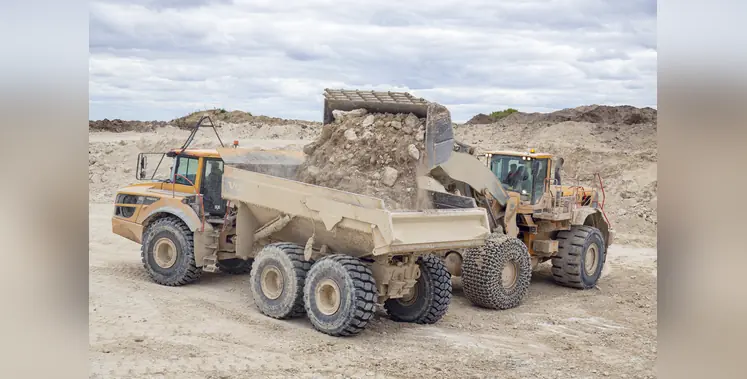
Robust HVAC systems are designed to withstand the dust, vibration, heat and extended operating cycles typical of mining applications. (Image source: Booyco Engineering)