








The growth of Africa’s mining industry is driving demand for robust solutions and heavy equipment built for the rigours of the continent, especially where it can be produced locally
Teams at South Africa’s Condra are working flat out to finish a series of crane orders for mines in Zambia, Namibia and South Africa.
The company has introduced additional shifts to complete a glut of what it calls “unusually large” overhead cranes now under manufacture at its Johannesburg factory — among them are three with boxgirders more than 30 metres long.
“These are very big, very long, very heavy fabrications to manage,” a Condra spokesman said.
On the floor currently are two 50-ton cranes with spans of 34 metres, and a third, high-lift, 5-ton crane with a 35-metre span.Condra is simultaneously completing manufacture of a further four 50-ton cranes with spans of around 20 metres.
All six 50-tonners are for a mine in Zambia, while the 5-tonner is for a Namibian mine.
Manufacturing challenges
Spans of 34 and 35 metres present unusual manufacturing challenges because of girder dimensions — besides length, box girders for these spans stand two metres high and just under one metre wide.
“Manufacture involves intricate welding and very careful jigging to incorporate the correct camber to counter girders’ natural tendency to sag under load,” the spokesman said.
“Girders this long are also quite delicate to manoeuvre on the shop floor. They require resource and workflow planning, and tie up use of our factory cranes.”
The spokesman added that end-carriage design has been important to ensure crane longevity, because the wheels must accommodate continuously changing stresses imposed by the girders as they flex under different loads.
“Our design team paid attention to both camber and end-carriage design to ensure durability,” he said. “Condra cranes are known for their low overall lifetime cost.”
Also under manufacture for Namibian mines are three single-girder overhead cranes, two portal cranes and a jib crane.The company behind these orders is an undisclosed engineering and project management consultancy with representation worldwide.
It has additionally ordered 18 electric hoists of between 2 and 25-ton capacity, and four chain blocks.
South Africa commissioning
In South Africa’s Northern Cape province, Condra is now commissioning two cranes at Gamsberg Phase Two, where the same consultancy contributed to metallurgy and process plant design.
These, too, are big machines: one a 40/5 ton crane with 22-metre span, the other an 80/20 ton machine with 18-metre span.
Gamsberg Phase Two is an expansion of the open-cast zinc mine near the town of Aggeneys, to double annual ore output from 4 million to 8 million tonnes.
Besides the cranes undergoing commissioning, Condra has completed delivery of two other cranes to Gamsberg Phase Two, for installation as the structural steelwork progresses.
The company reported that it anticipates further orders from southern and east Africa, notably Tanzania and Mozambique, where a marketing drive is currently under way.
Read more:
On-site power boost for Kamoa Copper
Byrnecut expands underground mining fleet with Sandvik equipment
Actom puts energy resilience centre stage at Electra Mining Africa
Mining growth drives demand for overhead cranes
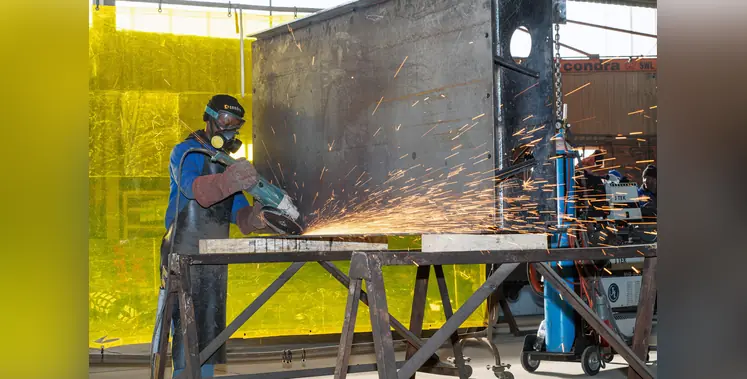
Factory work on a girder for one of the 50-ton, 20m-span cranes (Image source: Condra)