








In modern mining operations, safety challenges are intensifying as infrastructure becomes larger and more complex
Expanding conveyor networks, extensive underground systems and widely distributed electrical installations require reliable ways to transmit and verify shutdown commands across long distances.
According to Ian Loudon, international sales and marketing at Omniflex, fibre optic technology is playing an increasingly important role in ensuring these critical safety communications remain dependable.
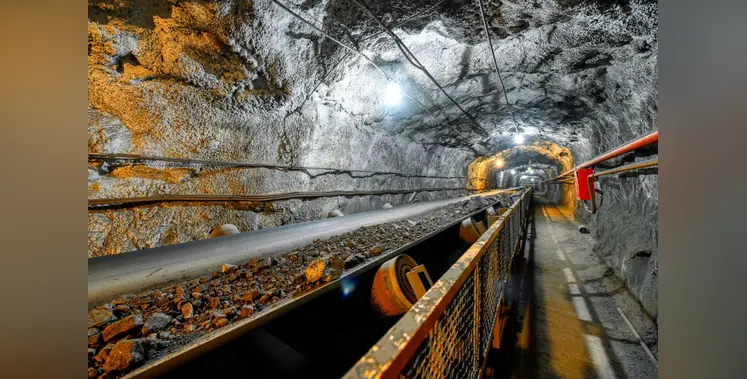
Conveyor systems remain central to the extraction, movement and processing of coal, yet they also present significant operational and safety risks. Over time, mining operations have expanded dramatically. Conveyor belts that once ran only a few hundred metres can now stretch for several kilometres, often traversing difficult terrain or operating deep underground. Maintaining safe operations across these extended distances requires robust emergency signalling, rapid shutdown capability and confirmation that commands have been successfully executed.
In many mines, conveyor belts can run between 20 and 30 km, incorporating multiple drive motors, synchronised programmable logic controllers and various loading or discharge stations along the route. If a fault develops at any point in this system, the potential for operational disruption or safety incidents increases significantly.
Historically, copper cabling was used to transmit safety signals, but this technology was not designed for the extended distances now typical in large mining operations. Over spans of 10 to 30 kilometres, copper wiring can suffer from signal degradation, voltage drops and electromagnetic interference generated by nearby electrical equipment such as motors, drives and switching systems. When repeaters are introduced to maintain signal strength, the overall system becomes more complex and vulnerable to additional points of failure.
These limitations mean copper-based signalling is increasingly unsuitable for modern mining environments, particularly those with long-distance infrastructure or heavy electrical activity. Extended copper runs are highly susceptible to electromagnetic interference and voltage loss, while attempts to extend signal transmission beyond roughly 10 kilometres generally require additional converters or amplification equipment. Underground conditions can further weaken signals, as dense rock formations and heavy electrical installations disrupt communication paths.
Another major drawback of traditional systems is their reliance on one-way signalling. When a shutdown command is issued, operators often only know that the instruction has been sent, not whether it has been received or executed. In situations involving critical equipment such as conveyors, crushers or ventilation systems, this uncertainty can create serious safety risks.
Fibre optic technology strengthens safety systems
To overcome the reliability challenges associated with copper cabling and conventional shutdown circuits, many mining operators are now adopting fibre optic communication for safety-critical applications. Fibre technology offers several important advantages in demanding mining environments. It is immune to electromagnetic interference, does not generate sparks and can reliably transmit contact signals across distances of 20 to 30 kilometres.
These characteristics make fibre particularly suitable for long conveyor systems, deep underground transport routes and electrically intense environments such as substations. By eliminating many of the vulnerabilities associated with traditional wiring systems, fibre optic networks provide a more resilient foundation for safety communications.
A key shift in modern safety strategies is the move from simply issuing a shutdown command to confirming that the action has actually taken place. In mining operations, the difference between a command being sent and a shutdown being verified can be critical. Without confirmation, equipment could continue operating despite problems such as a damaged conveyor belt, a stalled crusher or unsafe gas levels.
Specialised fibre optic devices designed for safety-critical applications support this approach. These include Safety Integrity Level rated bidirectional contact repeaters that replicate contact signals over long distances while simultaneously providing monitoring and feedback. Such systems transmit both the shutdown command and confirmation of the resulting action through the same optical link, allowing operators to verify the response in real time.
This architecture reduces uncertainty, simplifies wiring requirements and helps ensure compliance with mine safety protocols covering emergency shutdowns, isolation procedures and interlock systems.
As mining operations continue to expand and electrical systems become increasingly distributed, fibre optic signalling provides a reliable method of maintaining control across large and complex environments. Instead of relying on assumptions that commands have been executed, operators gain direct confirmation that machinery has stopped and systems have entered a safe state.
This level of verification supports stronger safety practices across the industry, reflecting a broader transition toward systems that confirm safety outcomes rather than simply issuing commands.
With extensive experience in long-distance and safety-critical environments, Omniflex has developed fibre optic modules designed to support bidirectional contact replication, auxiliary confirmation and fail-safe operation. These systems have been implemented in industries such as mining, nuclear power and electrical infrastructure where operational reliability and verified safety are essential.
Fibre optics transform long-distance mining safety systems
Fibre boosts mining conveyor safety