







In a major boost to the country’s energy sector, Tanzania has officially inaugurated the Julius Nyerere hydropower plant and dam (JNHPP) — officials hailed the move as a turning point for the East African country, which has long been plagued by electricity constraintsThe project, estimated to cost around US$2.8bn, is expected to more than double the nation’s generation capacity with a surplus that could support power exports, as well as drive domestic industrial growth.One of the largest dams in Africa, the 2,115 MW project was completed by an Egyptian joint venture of The Arab Contractors and Elsewedy Electric.The official inauguration ceremony was attended by Tanzania’s President Dr. Samia Suluhu Hassan and other dignitaries and included a joint field tour of key facilities:• The concrete dam extends for 1,036 metres and reaches 131 meters high.• The power house building at the hydropower plant comprises nine giant water turbines with a capacity of 235 MW each.• The 400-kV switchyard will transmit generated power and integrate it into the national grid via the Chalenzi 1 and Chalenzi 2 interconnection circuits.• The bridge built on top of the top of the dam body (Dam Crest Bridge) connects the two banks of the Rufiji River.• Behind the dam is a giant storage lake with a capacity of 34 billion cubic metres, equipped with seven water outlets to control and discharge water flows.The completion of the JNHPP project could bring relief to some of Tanzania’s major power consumers, including industries such as mining and cement, which have long faced challenges in securing reliable, affordable energy.The new electricity produced from JNHPP could improve stability of supply, ease costs and reduce reliance on thermal-based generators, or gensets.Read more:
Tanzania opens Julius Nyerere hydropower plant
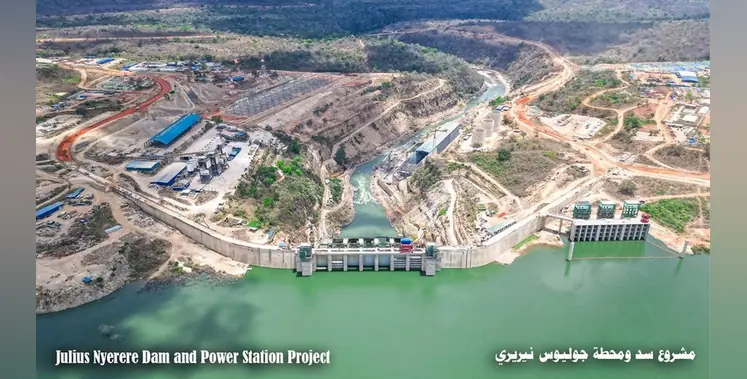
Aerial view of the new dam and power project (Image source: The Arab Contractors)