







Nuclear power could help meet Africa’s growing electricity needs, including rising demand from artificial intelligence (AI) and data centres, according to North-West University (NWU) principal and vice-chancellor Prof. Bismark Tyobeka
“It is a match made in heaven,” said Tyobeka, a nuclear energy expert, who made the case during an NWU public lecture on AI and nuclear power.
The argument comes as electricity demand from data centres is expected to rise sharply as AI develops.
The International Energy Agency (IEA) expects global data-centre electricity consumption to roughly double by 2030, although renewables are expected to meet a substantial share of the additional demand.
Tyobeka said many African countries would need additional reliable generation to support economic and technological growth.
“These two fields are converging to address one of the world’s most pressing energy challenges: delivering reliable, clean and secure electricity for a sustainable future,” he said.
“The need for more electricity therefore immediately accompanies our advances in artificial intelligence,” he said.
But we do not only need electricity, he added, we also need clean electricity.
Nuclear power can provide continuous, low-carbon electricity, while small modular reactors (SMRs) and microreactors are being developed as potentially more flexible alternatives to conventional plants.
“SMRs and microreactors are particularly well suited because their size allows them to be deployed almost anywhere. They can be built in factories,” said Tyobeka.
He also argued that AI could improve nuclear-plant safety and maintenance.“AI is a game changer,” he said.
“It can potentially enhance the safety features of nuclear power-plant designs. It can help us optimise the efficiency of nuclear power plants. It can also help us make rapid decisions across the entire nuclear value chain.”
However, nuclear projects face significant challenges, including high upfront costs, lengthy construction times, regulation, waste management and public acceptance.
“People do not trust AI as we sit here. People do not trust nuclear power as we speak. How do you secure buy-in from such suspicious people? Transparency is key.”
Tyobeka said nuclear investment could also support African mining, manufacturing and mineral processing.
“Nuclear power can enable Africa’s AI and industrial future. We have seen that the need is real and the opportunity is now.”
Read more:
China's DoGo Power launches in Mali
Solar power set for record growth in 2026
ePointZero to buy Azura Power majority share
Nuclear power key to Africa’s growing energy needs
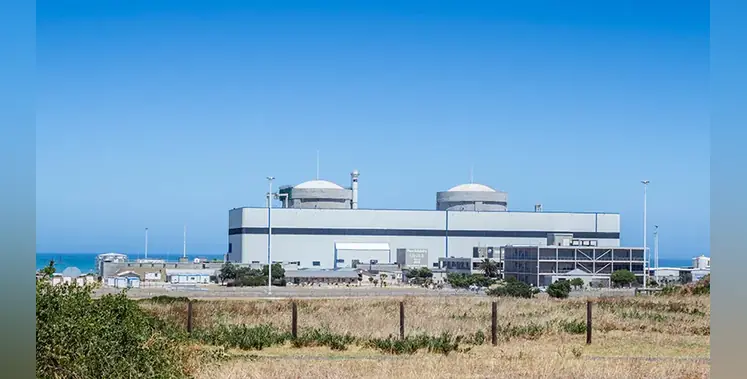
South Africa’s Koeberg nuclear power station (Image source: Adobe Stock)