







Kanadevia Inova AG (Inova) has signed a concession agreement for a 33.5-year waste-to-energy project in Morocco, scheduled for first operation in 2030
A wholly-owned subsidiary of Kanadevia Corporation, Inova’s role will cover the design, financing, construction and operation of the facility, to be located in Casablanca.
“The project will construct a waste-to-energy plant adjacent to Médiouna landfill, one of the largest landfill sites in Africa,” a Kanadevia Corporation statement read.
“The facility will process approximately 1.5 million tonnes of waste per year and have a power generation capacity of approximately 126 MWe. The objective is to hygienically treat waste while effectively utilising it as an energy resource.”
Inova will carry out the project with Nareva, a leading Moroccan integrated energy company, and Japan’s Itochu Corporation.
A Special Purpose Company (SPC) is to be established to implement the project while proceeding with engineering, procurement and construction (EPC) and long-term maintenance agreements.
The statement added that the facility will incorporate advanced technologies, including Inova’s large-scale combustion and boiler systems and its proprietary Autaro automatic combustion control system.
In addition, it will include a 50 MW solar power facility, a 4 MW landfill gas recovery and utilisation facility and a leachate treatment unit.
“By reducing methane emissions, which have a global warming potential approximately 28 times greater than CO2, the project is expected to generate around 1 TWh of electricity annually, equivalent to the annual electricity demand of approximately one million people,” the statement noted.
The facility has also been designed to enable the future introduction of carbon capture technologies (CCUS).
“By capturing, utilising, or storing CO2 contained in flue gases, the project aims to further reduce greenhouse gas emissions and support long-term decarbonisation.”
Read more:
First Quantum diversifies Zambia energy supply
Inova, Itochu plan Moroccan waste energy plant
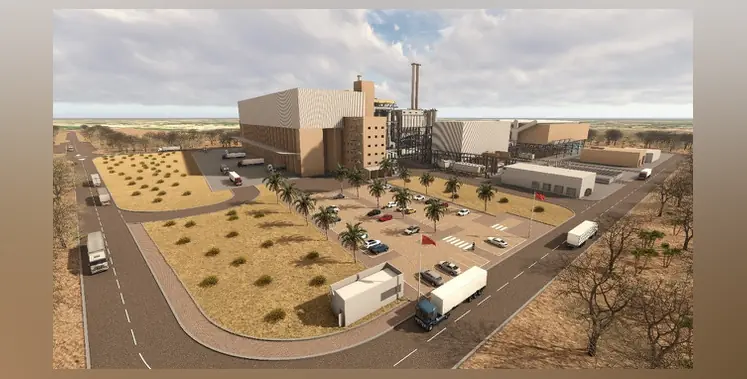
Artistic impression of the planned waste-to-energy project (Image source: Kanadevia Corporation)