Critical infrastructure, such as hospitals and clinics, require autonomous power systems capable of responding instantly to any power outage — a common theme throughout Africa
In Algeria, the situation is no different.
Himoinsa recently stepped in to plug the gap, supplying on-site power for a number of healthcare facilities across the North African country.
In the first project, it supplied almost 4 MW of emergency power with Yanmar engines for a hospital located in the municipality of Ain Benian.Another project was developed with other models with generator sets for a hospital located in Reghaia.
Together, both projects can now generate a total of 8 MW of essential power for Algeria’s hospitals.
The company worked with its local distributor Sarl Globale, ensuring the power autonomy of these healthcare centres with the HGY series, including two 2,500 kVA generator sets in Ain Benian — ensuring continuity of care and capable of responding immediately in the event of simultaneous grid failures.
HGY series
“The HGY series provides safe and efficient power solutions that enable continuous power supply to these critical services,” the company noted in a statement.
“HGY generators respond quickly and are designed to guarantee a response time of less than eight seconds and offer single-step load acceptance. The reliability and performance of HGY make it an indispensable choice for ensuring safety and efficiency in healthcare environments.”
The HGY-2350 D5 PRP generator sets installed at Ain Benian Hospital are equipped with high-performance Yanmar engines, developed specifically for mission-critical applications such as hospital environments.
Their high-pressure electronic injection technology enables a fast and stable response, ensuring immediate start-up and load acceptance in the event of a power failure.
In addition to offering excellent performance with optimised consumption, Yanmar engines are characterised by operational reliability even in demanding conditions, such as high temperatures or prolonged duty cycles.
Robust design and extended maintenance intervals also reduce technical interventions, ensuring constant power availability.
Challenging environment
The weather in Algeria, especially in coastal areas such as Reghaia and Ain Benian, is characterised by long, dry summers with temperatures exceeding 40°C during the hottest months.
This poses a challenge for power plant operations, as high air temperatures can cause power losses in thermal engines, a phenomenon known as derating.
The usual ambient temperature in the region required the installation of electric radiators capable of operating at 50°C, ensuring the nominal performance of the equipment.Both projects also required extreme soundproofing, with a maximum noise level of 75 dB(A) at 1 metre, as well as advanced thermal adaptation.
The set up at the two hospitals has been designed according to an operating philosophy that guarantees continuity of care through a system of two synchronised emergency generators, one main and one backup.
On a day-to-day basis, the hospital operates connected to the main grid; if this fails, the system automatically switches to the secondary grid.
If this fails, or both mains generator networks are not operating, the backup generator is started up.
Given that the hospital's total load does not exceed the capacity of a single generator, the system is programmed to keep one of the units on active standby – hot standby.
Once the load has stabilised, one of the units is disconnected, remaining available to take over the supply in the event of a failure of the operational generator.
Himoinsa developed this set up in conjunction with the generator control unit supplier, DEIF.
On-site power project for Algerian hospitals
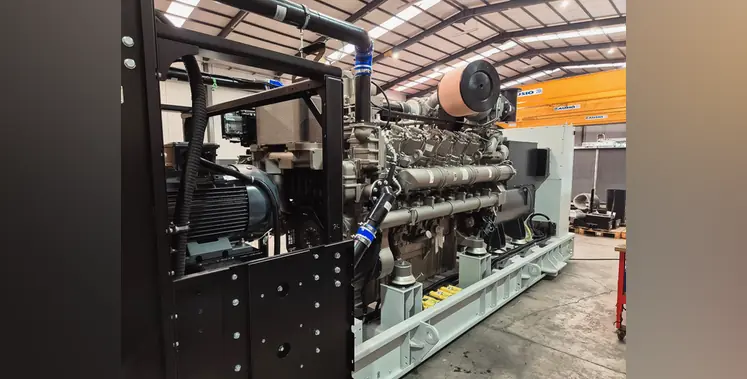
On-site power for Algerian hospitals (Image source: Himoinsa)