







Amid rising geopolitical tensions and increased defence spending worldwide, South Africa’s Booyco Engineering is strengthening its presence in the global defence sector with advanced industrial HVAC solutions tailored for highly specialised applications
The company has recently delivered complex cooling systems for radar jamming shelters as well as next-generation military amphibious vehicles. Grant Miller, executive director at Booyco Engineering, attributes this progress to the company’s extensive engineering expertise and established track record in delivering mission-critical HVAC technologies.
“We engineer our systems to suit the particular demands of complicated military equipment, designed for the harshest conditions while still meeting onerous specifications,” Miller says.
One notable project involves the integration of customised HVAC systems into hard-skinned radar jamming shelters manufactured in South Africa by ADG Mobility for export markets. These shelters, built on an ISO-container footprint, are designed to house sensitive electronic equipment, radar interference systems and ballistic protection capable of resisting light arms fire.
“This environment creates severe thermal and electromagnetic demands,” he explained. “Not only must the HVAC system maintain stable internal temperatures for both personnel and electronics, but it must do so while complying with rigorous electromagnetic interference (EMI) standards.”
To address these stringent requirements, Booyco Engineering developed its system in line with US military standard 461F, which governs electromagnetic interference in defence environments.
“When you are dealing with radar-related systems even small emissions can compromise performance - so the HVAC unit itself must be part of the protection strategy,” he said. “Acoustic considerations are also important, to ensure a quiet working environment; our system therefore operates at around 50 dB, significantly quieter than a typical office unit.”
The HVAC solution is engineered to operate under extreme temperature ranges, from as low as minus 40°C to as high as 55°C. It delivers a cooling capacity of up to 9 kW and heating of approximately 6,5 kW. In addition, the system is designed to withstand the intense shock and vibration associated with mobile military platforms, meeting both MIL-STD-810G and AECTP-400 standards.
“These shelters are mounted on military trucks that move over rough terrain, so the system must endure the same treatment,” Miller said. “It is not a plant room system; it has to survive real military deployment.”
Further enhancing its capability, the system incorporates chemical, biological, radiological and nuclear (CBRN) filtration alongside cyclonic dust filtration to perform in high-particulate environments. It also features integrated sensors, onboard carbon dioxide monitoring and advanced digital scroll compressors to maintain precise thermal control for sensitive equipment. Despite the complexity, the development timeline was notably accelerated.
“It has been a rapid development programme, made possible by the foundation of knowledge and experience Booyco Engineering has built up from previous systems engineering,” he said.
In another international project, Booyco Engineering is working with a Southeast Asian government to supply a specialised HVAC solution for a modern 8x8 amphibious infantry fighting vehicle. This system is designed to function in temperatures ranging from minus 10°C to 49°C, while also incorporating CBRN filtration and enhanced environmental protection.
“The CBRN system protects occupants of the vehicle from harmful gases or chemical agents,” Miller explained. “The filtration activates and removes harmful particulates and gases through high efficiency particulate air (HEPA) and carbon filters to protect both the crew and the vehicle’s electronics.”
The company’s long-standing relationship with this client, spanning nearly 15 years, has supported the development of systems capable of performing in extreme operational and climatic conditions. In amphibious environments, factors such as high humidity, salinity, rapid temperature changes and constant vibration present unique challenges for climate control systems. The current project includes the delivery of a full prototype along with several pre-production units for qualification testing.
Booyco Engineering expands global defence HVAC solutions amid demand
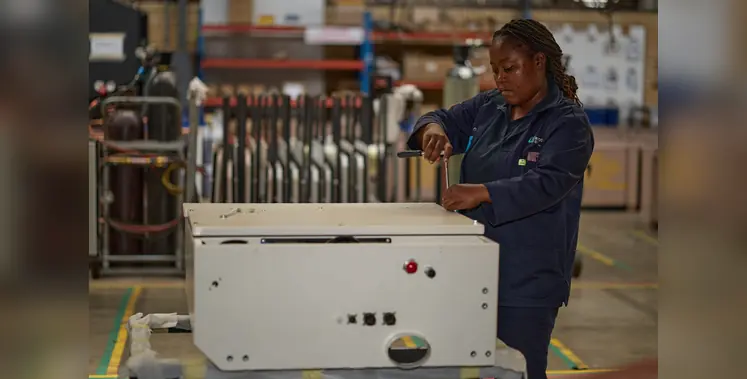
Advanced HVAC solutions for demanding global defence projects. (Image source: Booyco Engineering)