








As artificial intelligence (AI) investment accelerates globally, Africa is increasingly being viewed as the industry’s next major growth frontier, but according to Steven Santini, vice president for Secure Power, Sub-Saharan Africa at Schneider Electric, the continent’s AI ambitions will ultimately depend on its ability to solve one critical challenge: infrastructure readinessSpeaking at this year’s IDC CIO Summit 2026, a premier gathering for technology decision makers, held at the Sandton Convention Centre in Johannesburg, Santini said global AI players are already looking toward Africa as a strategic investment destination.“The question becomes: is Africa ready? Global AI players increasingly view Africa as the next frontier, the new gold rush, in many respects. We have the land, the resources, and the growth potential. As many have already seen, data centres are being developed across Kenya, Nigeria, South Africa and other regions where investment is welcomed.”However, while momentum around AI infrastructure is rapidly building, Santini cautioned that the continent faces significant barriers that could slow adoption if not addressed strategically.“Power remains the number one challenge for AI, particularly AI data centres. To put this into perspective, some of the projects we are involved with in the Middle East have power requirements comparable to entire cities.”Focus on smaller infrastructure tooHe added that Africa’s infrastructure conversation cannot focus solely on hyperscale facilities. Instead, organisations should rethink how AI is deployed and where it delivers the greatest operational value.“When people hear ‘AI’, they often picture massive hyperscale data centres. But AI exists in many different forms. Your laptop can run AI workloads. A small ten-node server cluster deployed at an industrial site can support AI applications. AI does not always require enormous, high-density centralised environments.”Santini believes this shift is particularly relevant for Africa, where industries such as mining, agriculture, financial services, and government are increasingly adopting AI to improve operational efficiencies, automation, predictive maintenance, and decision-making closer to the edge.“We are seeing many African organisations deploying smaller AI environments through prefabricated systems, containerised data centres, or even single racks within existing facilities. This allows them to leverage existing cooling and power infrastructure while simplifying deployment.”He adds that connectivity remains just as important as power in enabling AI success across the continent.“A data centre without reliable network infrastructure is effectively just an expensive paperweight. If data cannot move efficiently in and out, the infrastructure cannot deliver value.”All parties at the tableBeyond physical infrastructure, Santini highlighted the growing importance of software intelligence in helping organisations maximise energy efficiency and optimise cooling performance in increasingly power-constrained environments.“We live in a world where power is constrained and nowhere is that reality felt more strongly than in Africa. Because of this, we need both the right physical infrastructure and the right software intelligence to maximise efficiency and performance.”Ultimately, Santini believes Africa’s AI success will depend on aligning infrastructure investments with clearly defined business outcomes rather than pursuing AI for its own sake.“AI in Africa is not a future concept is already happening. But success will depend on defining the right operational outcomes first, and then aligning the appropriate technologies, power, cooling, computing, storage, and networking around those goals.”“As Schneider Electric, we position ourselves as the energy technology partner helping organisations achieve those outcomes efficiently and sustainably,” he concluded.Read more:
Africa’s AI ambitions face critical infrastructure questions
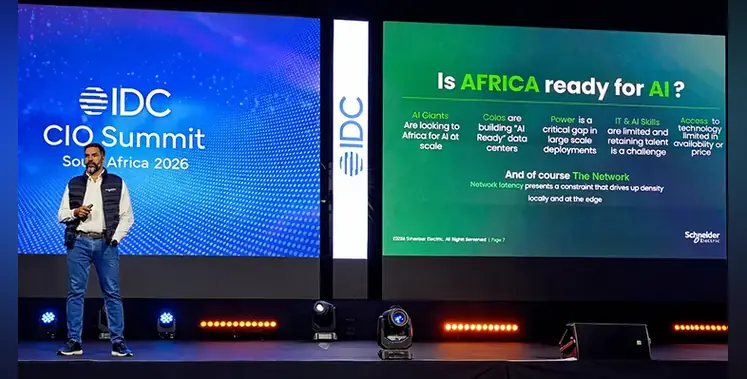
Schneider Electric’s Steven Santini at the IDC CIO Summit 2026 in Johannesburg