cb.web.local

twitter Facebook Linkedin acp Contact Us

Energy

IEA reports energy sector employment reached 76 million in 2024, but skilled labour shortages threaten progress.

Strong global investment in energy infrastructure helped push energy-sector employment up by 2.2% last year, almost twice the pace of job growth across the broader world economy, according to a new report from the IEA

The World Energy Employment 2025 report, published today, indicates that the global energy workforce expanded to 76 million in 2024, marking an increase of over five million positions compared to 2019. Over the past five years, the sector has accounted for 2.4% of all net new jobs created globally.

Much of this momentum stems from the power sector, which has generated three quarters of recent employment gains and now stands as the largest employer in energy, surpassing fuel supply. Solar PV continues to be a central catalyst for hiring, supported by notable expansions in nuclear power, electricity grids and energy storage. As electrification accelerates across various industries, employment in EV manufacturing and battery production surged by nearly 800,000 roles in 2024.

Fossil fuel employment demonstrated resilience throughout 2024. Coal sector jobs climbed in India, China and Indonesia, lifting coal industry employment 8% above 2019 levels despite steep reductions in advanced economies. Meanwhile, oil and gas companies have recovered most of the positions lost in 2020, though falling prices and economic uncertainty have prompted workforce reductions in 2025. Early indicators suggest that overall energy-sector job growth is likely to ease to 1.3% this year, with tight labour markets and geopolitical tensions prompting businesses to slow hiring.

Despite the sector’s strong hiring record, the report flags a worsening shortage of skilled workers. More than half of the 700 companies, labour unions and training organisations surveyed through the IEA’s Energy Employment Survey cited severe recruitment challenges that risk delaying infrastructure development, slowing major projects and increasing system costs.

“Energy has been one of the strongest and most consistent engines of job creation in the global economy during a period marked by significant uncertainties,” said Fatih Birol, IEA executive director. “But this momentum cannot be taken for granted. The world’s ability to build the energy infrastructure it needs depends on having enough skilled workers in place. Governments, industry and training institutions must come together to close the labour and skills gap. Left unaddressed, these shortages could slow progress, raise costs and weaken energy security.”

Technical and applied roles including electricians, pipefitters, line workers, plant operators and nuclear engineers remain among the hardest to fill. These occupations have collectively added 2.5 million jobs since 2019 and now make up more than half of the global energy workforce, more than double their share of total employment across the wider economy.

Demographic pressures are also mounting. In advanced economies, 2.4 energy-sector workers are nearing retirement for every new entrant under the age of 25. Nuclear and grid-related professions face some of the most acute ageing dynamics, with retirement-to-new-entrant ratios of 1.7 and 1.4 to 1 respectively.

Meanwhile, the number of newly trained workers entering the field is insufficient to meet demand. To prevent the skills gap from widening further by 2030, the global pool of newly qualified energy workers would need to expand by 40 percent. Achieving this increase would require an estimated US$2.6bn in additional annual investment, less than 0.1 %of total global education spending.

The report emphasises that policy interventions can help reverse these trends. Survey respondents cited training costs, forgone wages and limited awareness of available programmes as major barriers to workforce entry. Effective approaches include targeted financial support for learners, broader apprenticeship offerings, greater industry participation in curriculum development and expanded investment in training centres. Additionally, reskilling within the sector is becoming increasingly important. While certain regions are already experiencing declines in fossil fuel employment, strategic retraining programmes could enable workers to transition into fast-growing segments of the energy system.

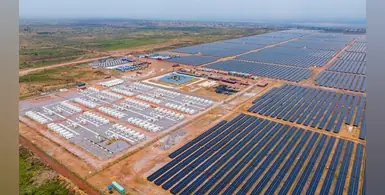
Cazombo photovoltaic park in Angola (Image source: MCA Group)

Portuguese group MCA has just energised Africa's largest off-grid renewable energy photovoltaic (PV) park in Angola

The site will supply green energy to more than 136,000 people, with a production capacity of 25.40 MWp and batteries with a storage capacity of 75.26 MWh.

It is the country’s first autonomous, off-grid system with a solar source and battery bank for night-time supply – meaning that no fossil fuels will be consumed.

The inauguration was attended by Angola’s Minister of Energy and Water (MINEA), João Baptista Borges.

Manuel Couto Alves, chairman of the MCA Group, said that “the delivery of this first park, with cutting-edge technology and operating models adjusted to the evolution of local demand, represents our ability to adapt and our flexibility in responding to specific contexts.”

The project, with more than 40,000 solar panels installed, generated 300 jobs and enable annual savings of around 10 million litres of fuel, avoiding the emission of 37 tonnes of CO2 using renewable energy.

“For us, this project represents not only a technical challenge overcome with excellence,” added Alves, “but also a significant transformation in the quality of life of the communities involved. It is with a sense of accomplishment that I see people's homes lit by green energy.”

The financing for the project was structured by the UK’s Standard Chartered Bank with the support of German Export Agency, Euler Hermes, which granted a guarantee of around €1bn reinsured by Cosec and K Sure, the Portuguese and Korean export credit agencies (ECA).

The public electricity production company, PRODEL Ep, is the promoting entity.

The Angolan municipality of Cazombo, with a population of around 411,074 inhabitants, is the capital of the province of Moxico Leste.

The commissioning of the new park represents the first major source of electricity production and distribution in the region.

The Cazombo photovoltaic park forms part of a broader Rural Electrification Project in Angola that began in 2023 and is expected to be completed in 2026.

As well as MCA Group, it involves the Angolan government through the Ministry of Energy and Water and the Ministry of Finance, as well as a consortium of banks represented by Commerzbank AG as agent, and the German ECA, Euler Hermes.

As part of this project, MCA will also build 46 isolated solar mini grids to benefit more than one million people in 60 communes in the interior of the country, located in the provinces of Malanje, Bié, Lunda-Norte, Lunda-Sul and Moxico.

Photovoltaic power of 256MWp and 595 battery storage will be generated, and more than 200,000 household connections will be made.

Read more:

OCP Green Energy commissions Morocco's largest solar project

Mitrelli Group completes Angola's Quibala substation

Africa construction market drives Mota-Engil growth


Hussein Shoukry to lead MEA operations. (Image source: Siemens Energy)

Siemens Energy has named Hussein Shoukry as the new managing director for the Middle East and Africa. He takes over from Dietmar Siersdorfer, who is retiring after an impressive career spanning nearly four decades with the company.

Based in the UAE, Hussein will oversee Siemens Energy’s operations and strategic initiatives across a regional network of 29 offices, employing more than 4,000 people and generating EUR 9 billion in order intake in fiscal year 2025.

“Rising energy demand is reshaping the future of both the Middle East and Africa,” Hussein said. “In the Middle East, countries are embracing a diversified energy mix and building localized supply chains, while in Africa the priority is expanding reliable electricity access for millions. The region also includes markets where critical energy infrastructure is being rebuilt or modernized.”

He added, “With our broad portfolio in energy technology and long-standing presence, Siemens Energy will remain a committed partner in meeting these needs and strengthening the resilience of the Middle East and Africa’s energy systems.”

Hussein brings extensive experience in managing complex energy projects and enhancing global execution capabilities. Since joining Siemens Energy in 2003, he has held multiple leadership roles, most recently as Senior Vice President for Project Execution, where he led a team of over 3,500 employees and managed the company’s global Competence Centers in Romania, Mexico, and India.

Holding a degree in Construction Engineering from the American University in Cairo, Hussein’s engineering background, project execution expertise, and deep understanding of diverse energy markets across Europe and the Middle East equip him to lead Siemens Energy’s business in the Middle East and Africa effectively.

Morocco’s largest solar project commissioned

OCP Green Energy, the renewable energy subsidiary of OCP Group, has commissioned the first phase of its investment program, delivering a total solar capacity of 202 MWp

The portfolio spans three sites: Benguerir (67 MWp), Foum Tizi (30 MWp), and Oulad Farès in Khouribga, with Oulad Farès now the largest photovoltaic plant in operation in Morocco at 105 MWp.

These solar farms support OCP Group’s mining and industrial operations by covering a significant share of energy needs, reducing the carbon footprint, and providing low-cost electricity, estimated at around 368 MAD/MWh, for the production of customized fertilizers. Developed under the authorisation of Morocco’s Ministry of Energy Transition and Sustainable Development, the projects comply with national grid regulations and involve connection agreements with ONEE to optimise power transmission across OCP’s sites, including desalination plants and strategic industrial facilities.

OCP Green Energy executed the projects with strong involvement from local Moroccan industrial partners across engineering, design, and construction, completing the phase on time, on budget, and to international standards. Representing nearly MAD 1.8 billion in investment, the projects also benefited from international financing, including €100 million from the IFC and support from KfW and the Clean Technology Fund.

Omar Kadir, managing director of OCP Green Energy, stated, “Integrating a solar plant at the heart of an active mining site, without disrupting its operations and while strictly complying with grid code standards, represented a major challenge. Thanks to OCP Group’s support, our teams’ commitment, and close collaboration with the IFC and other financial and industrial partners, we have delivered this project in line with the best international practices in safety, performance, and sustainability — demonstrating our ability to combine operational excellence with energy transition.”

Alongside the solar farms, OCP Green Energy is launching the Battery Energy Storage System (BESS) Phase I project in Benguerir, the first confirmed deployment of LFP batteries in Morocco. With a capacity of 25 MW / 125 MWh, the system will store solar energy for use during peak hours, ensuring continuous renewable supply, improved demand management, and enhanced grid flexibility.

“Large-scale deployment of storage technology is a true inflection point that accelerates the rollout of renewable capacity. By leveraging this flexibility, we significantly reduce the intermittency of renewable sources, ensure better alignment with demand profiles, reinforce grid stability, and thereby secure greater integration into the national power system,” added Kadir.  

Looking ahead, OCP Green Energy plans to expand its renewable portfolio to 1.2 GW by 2027 and over 2 GW beyond, including at least 2 GWh of storage. The initiative is central to OCP Group’s energy transition strategy, aiming to fully meet industrial electricity needs from renewable sources by 2027 and achieve carbon neutrality by 2040, while strengthening the company’s low-carbon competitiveness globally.

NCP Chlorchem and Terra Firma unveil one of South Africa’s largest industrial behind-the-meter solar programmes at Johannesburg site. (Image source: NCP Chlorchem)

NCP Chlorchem, one of South Africa’s leading producers of chlorine and essential water treatment chemicals, has partnered with Terra Firma , a top developer of commercial and industrial solar and battery-storage projects, to launch a 27 MWp multi-phase solar initiative

This programme ranks among the largest standalone behind-the-meter solar installations in the country and will power NCP’s primary manufacturing site.

The site is designated as a National Key Point due to its vital contribution to providing safe, potable water to millions across South Africa. The solar rollout will meet a considerable portion of the facility’s power needs, with several phases already operational. More capacity is expected to be added in early 2026, and the full programme is projected for completion by the end of that year.

As core industries navigate high electricity prices, grid instability and increasing demands to cut carbon emissions, onsite renewable energy is becoming an essential part of long-term operational and financial planning.

NCP’s production processes require substantial amounts of energy, making reliable long-term energy supply and emissions reduction fundamental to its sustainability agenda. The company began its solar partnership with Terra Firma in 2023 through a 1.1 MWp pilot system, installed under earlier regulatory constraints that capped project size. After the pilot proved successful, NCP progressed to a 10 MWp second phase consisting of rooftop, carport and ground-mounted systems, now nearing commissioning. Construction of an additional 17.5 MWp is underway, bringing the total solar capacity to 27 MWp.

“As a producer of essential chemicals used in water and sanitation, sustainability is central to how we operate,” said Schalk Venter, managing director, NCP. “Working with Terra Firma has allowed us to lower our carbon emissions and manage long-term energy costs more effectively. It’s a major step in building a more resilient and sustainable future for our operations.”

“As South Africa’s energy transition accelerates, more large energy users in complex industrial sectors are turning to onsite renewable systems to meet their cost and sustainability targets,” said Grant Berndsen, CEO, Terra Firma.

“Supporting a facility as vital as NCP’s, where uninterrupted operations are essential to public health, highlights the importance of getting these projects right. Integrating a 27 MWp solar system into a live chemical production site demands careful planning and collaboration, with the highest possible safety standards and processes. The success of this programme shows how renewables can be delivered effectively within such a high-stakes environment. It sets a benchmark for secure, compliant industrial decarbonisation.”

More Articles …