





cc.web.local

Dangote to boost Kenya's fuel supply (Image source: Adobe Stock)

As Africa looks to strengthen its energy security from within, a new generation of home-grown industrial projects is reshaping the continent’s fuel landscape

Dangote’s latest refinery venture in Kenya is another sign of African capital and expertise being mobilised to build the infrastructure needed to meet Africa’s growing energy demand.

Honeywell Technologies has been chosen by Dangote Petroleum Refinery and Petrochemicals FZE to assist in its Kenyan refinery project in a deal worth around US$300mn.

It will provide process technologies, licensing, engineering services, proprietary catalysts, equipment and digital solutions for the planned 700,000 barrel-per-day (bpd) refinery.

Once complete, the facility is expected to become the world’s largest single-train refinery.

Dangote, Honeywell collaboration

The project builds on nearly a decade of collaboration between the two companies and leverages proven engineering designs that Honeywell Technologies developed for Dangote’s refinery in Lekki, Nigeria (Honeywell powers Dangote's bold refinery capacity transformation).

In a statement, Honeywell Technologies said that Dangote’s ability to draw on these established designs will help reduce the development schedule for the new facility by nearly two years – nearly 30% sooner than typical newly constructed facilities.

“Large-scale refinery projects require a combination of proven technologies, engineering expertise and digital capabilities,” said Rajesh Gattupalli, president of Honeywell Technologies UOP.

“Through our long-standing relationship with Dangote, we have developed proven large-train engineering designs that can be applied to the Kenya refinery to help significantly reduce time-to-market. We will also provide modifications that enable the refinery to process a wide range of crude feedstocks, helping improve operational flexibility and reduce reliance on any single crude source or supply region.”

The Kenyan refinery will produce gasoline, diesel, jet fuel and polypropylene.

It will also have the flexibility to process a wide variety of crude oils, from light to heavy grades, enabling the use of feedstocks sourced from multiple regions and reducing reliance on any single supply source.

Fund-raising efforts

The announcement comes as Dangote works through an initial public offering (IPO) to raise funds for the expansion of its refinery in Nigeria and the new facility in Kenya.

The IPO worth US$1.6bn is believed to be Africa’s largest to date (Dangote refinery seeks US$1.6bn in Africa's biggest IPO).

The company has also been raising additional funding to assist with its growth plans (Dangote refinery secures US$2.5bn investment ahead of expansion).

“Dangote is committed to expanding Africa’s refining capacity and strengthening long-term energy security for the continent while also serving growing export markets,” said Aliko Dangote, president, Dangote Petroleum Refinery and Petrochemicals FZE.

“Our proven collaboration with Honeywell Technologies will enable us to bring the facility online faster and provide the flexibility to process a broad range of crude oils. Together, these capabilities will help us meet growing global demand for fuels and petrochemical products.”

In its statement, Honeywell Technologies said the new project underscores how proven refining technologies and digital solutions can help accelerate project execution while supporting energy security, supply chain resilience and economic growth.

Over the past year, Dangote announced that Honeywell Technologies would provide licensing, engineering, catalyst, digital services to help boost fuel and petrochemical production and enhance workforce capabilities at the Lekki facility, as well as support efforts to increase refining capacity, optimising existing assets and accelerating market delivery.

The company has also put in place other deals with equipment suppliers ahead of its group-wide expansion (Dangote seals XCMG refinery infrastructure pact).
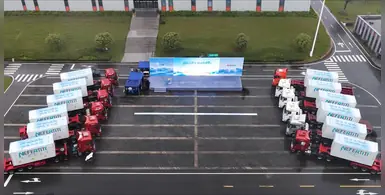

The storage systems will support renewable energy integration at two major sites. (Image source: Gotion)

Egypt is set to deploy large-scale battery energy storage systems across the Nefertiti and Horus projects, with Gotion Grid supplying its 5MWh storage systems for what will be Africa’s largest standalone energy storage facilities once completed

The projects, developed by AMEA Power and built by China Energy Engineering Group, represent Egypt’s first large-scale standalone energy storage projects. The systems are intended to strengthen grid stability, support the integration of solar and wind power, and contribute to Egypt’s 2030 clean energy goals.

Gotion has begun global delivery of the equipment, with 50 heavy-duty trucks carrying its self-developed Gotion Grid 5MWh storage systems departing simultaneously from its Jinzhai and Nantong facilities.

The storage systems will support renewable energy integration at two major sites. At the Benban solar complex, the technology is designed to enhance solar power consumption, while at the Zafarana wind farm it will provide flexible peak-shaving capabilities.

The systems have been upgraded for operating conditions including extreme heat, sandstorms and salt fog. According to Gotion, their capabilities include high-voltage stability, high safety and millisecond-level response, features intended to support reliable operation in Egypt's challenging environmental conditions.

The deployment also highlights the role of battery energy storage in managing variable renewable generation. By storing electricity and providing flexible grid support, standalone storage can help align renewable power generation with periods of demand and provide additional operational flexibility for power systems with increasing shares of solar and wind generation.

Gotion completed the first shipment within three months of signing the project, reflecting its role in large-scale storage integration, global supply chain coordination and localised delivery.

"This shipment opens a new stage of broader cooperation," said by Hussain Al Nowais, chairman of AMEA Power, "We are proud and satisfied with our partnership with Gotion and are actively exploring new opportunities across the Middle East and Africa."

Li Chen, Senior vice-president of Gotion and president of Gotion Americas said, "Egypt is Gotion's key step into the Middle East and North Africa, proving it can deliver end-to-end, operate locally, and commit for the long term."

Dangote is seeking to bolster Nigeria’s fuel supplies (Image source: Adobe Stock)

The proposed expansion of Nigeria’s Dangote oil refinery marks a significant step in the West African country’s push to build up domestic fuel production and reshape its role in the continent’s oil industry

An initial public offering (IPO) in the refinery has attracted “enormous” support from investors, according to the group’s founder, Aliko Dangote.

The US$1.6bn IPO is now open in a bid to raise additional funding to double capacity.The Lagos refinery is a key installation to ease energy shortages in the West African country, one of the continent’s biggest oil and gas producers.

The funds will partially finance a massive capacity expansion to 1.4 million bpd by 2029.

The IPO comes as Nigeria seeks to strengthen its domestic energy supply and reduce reliance on imported refined petroleum products, while also positioning itself as a major refining hub for West Africa.

The scale of the expansion also reflects the growing ambitions of Africa’s private sector to finance large, strategically important infrastructure projects through local capital markets.

Dangote told reporters in Kenya, where the group plans a separate refinery, that the outlook for the IPO is encouraging.

“Demand is there, enormous demand,” he was quoted as saying by Reuters.“In fact, I didn’t know the depth of our capital markets until now, really, because we have never tested it,” he added.

The IPO, Africa’s largest to date, is scheduled to close 13 October, 2026.

The Nigerian refinery, located in Lekki, Lagos, commenced operations in 2024, and is the largest single-train oil refinery in the world.

In Kenya, Dangote is hoping to replicate its refining ambitions in East Africa with a planned 700,000 bpd refinery in Lamu, although the project has faced local challenges.

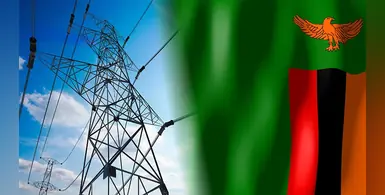
New funding to help unlock Zambia's energy potential (Image source: Adobe Stock)

New investment in Zambia’s energy sector will help fund generation and transmission projects in the country and open up network and trading opportunities across southern and eastern Africa

Bordering eight countries and sitting within the Southern African Power Pool, with growing links to East and Central Africa, Zambia is positioned as a natural hub for regional power trade.

It follows a US$250mn financing deal between Swiss energy and commodities group Mercuria with Africa-focused investor Exergy.

Specifically, the funds will help to finance generation and transmission projects by two Exergy subsidiaries: Lunzua Power Company and Lusitu Transmission and Distribution Company.

• US$250mn investment will boost Zambia’s power infrastructure

• Projects will strengthen regional electricity trade

• Investment supports Zambia’s 10,000 MW power target by 2031

Exergy operates in the power sector through three subsidiaries: Lunzua Power in generation, Lusitu Transmission and Distribution in transmission, and Kanona in trading, balancing surplus and deficit positions.

It trades in the southern African power market and is developing a pipeline of infrastructure projects, including a transmission highway linking Zambia to the East African power market.

“Through its subsidiaries, its pipeline will contribute to Zambia’s target of 10,000 MW of supply by 2031, a central pillar of the Grow Zambia agenda, and to the reliable supply needed by mining, agriculture, manufacturing, tourism, and industry,” an Exergy statement noted.

“Regionally, its trading and cross-border ambitions support Mission 300, the World Bank and African Development Bank initiative to connect 300 million Africans to electricity by 2030.”

The financing agreement, signed in Lusaka and subject to regulatory approvals, marks one of the largest private capital commitments to Zambia’s energy sector, as well as Mercuria’s entry into the region’s power market.

Zambia confidence

According to Exergy, the deal signals confidence in Zambia, in the region, and in the ability of global partners to finance African energy at scale on commercial terms.

The company also added that Mercuria brings more than capital: as one of the world’s largest energy traders, active in over 50 countries, it offers a global view of energy and commodity markets, and of how power, metals and trade connect.

According to Mercuria, Zambia’s stability, growth plan and regional position underpinned its decision to commit long-term capital.

The company “is pleased to play its part in resolving the power infrastructure bottlenecks that have traditionally hindered Africa’s growth,” a Mercuria statement read.

“In doing so, it sought power industry expertise, a disciplined team and an execution-ready project pipeline, and found all three in Exergy—a scalable regional platform it wants to help build.”

Zambia has seen a wave of new investment and projects in renewable energy in recent years, in addition to traditional hydro and thermal capacity (First Quantum diversifies Zambia energy supply).

Private capital

Mercuria added that it sees private capital playing a critical role in developing strategic energy infrastructure, alongside the traditional development finance model.

Both parties credited Zambia’s power sector reforms, including open access in the electricity market, with enabling independent companies to build and grow.

As well as investment in renewables, the country continues to develop traditional energy sources, such as hydro (Anzana Electric nets US20mn for small hydropower) (Globeleq completes Lunsemfwa hydro acquisition).

Green hydrogen and ammonia plant set for South Africa (Image source: Hive Energy)

Técnicas Reunidas has landed an engineering services contract for a large green hydrogen and ammonia plant planned for South Africa

Hive Hydrogen South Africa (HHSA) has awarded the company the front-end engineering design (FEED) contract for a facility that will produce approximately one million metric tons of green ammonia annually in an industrial zone located in Nelson Mandela Bay.

The project will utilise local renewable electricity to produce green hydrogen, which will subsequently be converted into green ammonia for domestic use and international export.

“Our aim remains to produce the lowest cost green ammonia globally,” said John Nutt, Hive’s technical director.

Following completion of the engineering work, and once a final investment decision is made, the FEED contract is expected to be converted into an EPC (engineering, procurement, and construction) contract for the actual construction of the plant.

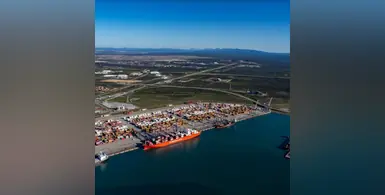
The green hydrogen and ammonia facility is being developed in the Coega Special Economic Zone, adjacent to the Port of Ngqura, in Eastern Cape Province.

According to HHSA, the projected investment for the production plant would reach US$1.8bn.

The scope of work Técnicas Reunidas will carry out under the FEED contract includes hydrogen production electrolysers, air separation units, and the green ammonia production loop; a desalination plant; storage systems with a capacity of over 100,000 metric tons; pipelines to the port of Ngqura; and auxiliary facilities.

Gonzalo Pardo of Técnicas Reunidas said the company is delighted to have been selected by Hive.

“Leveraging our deep technology expertise and end-to-end EPC vision, we look forward to delivering a successful FEED and contributing to Coega’s role as a benchmark for Africa’s sustainable industrial growth,” said Pardo.

“Furthermore, this award is perfectly aligned with the strong focus on services projects that Técnicas Reunidas is currently implementing as part of its…strategic plan.”

Read more:

Exergy to pursue East Africa's clean energy opportunity

Nuclear power key to Africa's growing energy needs

Solar power set for record growth in 2026 

More Articles …