SANRAL awards R1.43bn Gauteng road resurfacing contracts

The South African National Roads Agency SOC Limited (SANRAL) has awarded three road resurfacing contracts worth approximately R1.43bn across the City of Tshwane and City of Ekurhuleni metropolitan municipalities, targeting improvements to key sections of Gauteng's national road network

The projects cover the R21, N3 and N17 highways and form part of SANRAL's programme to maintain national road infrastructure, strengthen road safety and create economic opportunities for surrounding communities.

Construction on all three projects will commence following a three-month mobilisation period. Progress Hlahla, SANRAL's Gauteng Provincial Head, said the contract awards would support the upkeep of important transport routes used for passenger and freight movement.

“I am pleased with the awards of these projects as they represent the work that SANRAL puts in the upkeep of Gauteng’s national road network. These routes are important for the transportation of goods and people, connecting communities and facilitating economic activity. The improvement of these routes will ensure that our infrastructure continues to serve road users safely and efficiently,” said Hlahla.

Three national routes set for rehabilitation

The largest contract, valued at R499.8mn, has been awarded to Roadmac Surfacing (Pty) Ltd for resurfacing the R21 between the Olifantsfontein and Hans Strydom interchanges in the City of Tshwane.

Work is scheduled to begin in early January 2027, with completion expected in April 2028. The programme includes road resurfacing, replacing danger plates at culvert structures, installing new permanent regulatory and warning signs, replacing guardrails where necessary, and applying fresh road markings and road studs.

Roadspan Surfaces (Pty) Ltd has secured the R463mn contract for the N3 section between the Heidelberg Road and Geldenhuys interchanges in the City of Ekurhuleni.

Construction is expected to begin towards the end of February 2027 and finish in September 2028. Planned works include resurfacing, drainage repairs, guardrail installation and replacement, and upgrades to road signs, markings and studs.

The third contract, worth approximately R469.5mn, has also been awarded to Roadmac Surfacing (Pty) Ltd. It covers the N17 between Springs and the Leandra Interchange, beginning in the City of Ekurhuleni and extending into the Gert Sibande District in Mpumalanga, ending near the Leandra toll plaza.

Construction is expected to start in mid-May 2027. The work will involve removing the existing asphalt and laying a new surface, alongside replacing bridge joints.

Contracts create opportunities for local communities

Alongside the road improvement works, SANRAL has incorporated public participation and skills development requirements into the contracts. A total of 30% of the final contract award value for each project will be allocated to public participation initiatives.

These provisions will create opportunities for targeted labour and enterprises, including businesses owned by young people, women, military veterans and persons living with disabilities.

The projects will also provide community-based training opportunities through Technical and Vocational Education and Training (TVET) colleges and universities.

“Whilst the primary objective of these awards is for construction, we also recognise the importance of creating opportunities for meaningful participation and skills development for people and small businesses within the communities in which we operate,” added Hlahla.
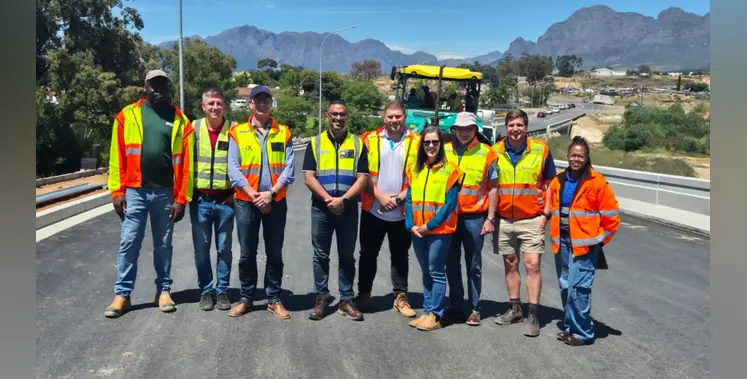

Western Cape advances a R1.165 billion road upgrade to improve Franschhoek Pass safety. (Image source: Western Cape Government)

The Western Cape Government is advancing a R1.165 billion (approx. US$12.25mn) road improvement and flood-recovery project along Franschhoek Pass, focusing on safer travel, improved regional connectivity and stronger infrastructure capable of withstanding extreme weather

Led by the Department of Infrastructure, the MR191 project includes road upgrades, resurfacing, drainage improvements and repairs to sections damaged by repeated flooding. Construction is expected to be completed in July 2027, subject to favourable conditions.

Franschhoek Pass is expected to reopen during the construction holiday, from mid-December to mid-January, with stop-and-go traffic controls in place. However, the reopening will depend on safety assessments, and the road will remain closed if conditions are considered unsafe.

Repeated flooding prompts major road repairs

Severe rainfall in October 2023 caused 16 slope failures and slips along Franschhoek Pass, leaving sections of the route damaged. Further heavy rainfall in May 2026 resulted in five additional slips and erosion at the Du Toits River bridge abutment on the Villiersdorp side.

The recurring damage has highlighted the challenges of maintaining transport links in areas exposed to extreme weather. The additional flood-recovery work has therefore been incorporated into the wider MR191 improvement programme, combining urgent repairs with measures intended to improve long-term road resilience.

Engineering measures target road safety and slope stability

The project covers several sections of the road network, with work focused on upgrading deteriorated surfaces, improving drainage and stabilising vulnerable slopes.

Approximately 9.57 km of MR191 between Old Paarl Road (MR189) and Helshoogte Road (MR172) is being widened and upgraded to a Class 1 road. Rehabilitation work also covers approximately 14 km between the Helshoogte intersection and the Franschhoek urban area, as well as approximately 16 km between Franschhoek and the Theewaterskloof Dam.

Construction activities include asphalt surfacing, pavement reconstruction, drainage upgrades and repairs to the Du Toits River bridge abutment. Specialist slope protection measures include soil nails, high-strength steel mesh, anchored gabion walls and reinforced concrete structures.

These engineering interventions are designed to address existing damage, improve road stability and reduce the risk of further deterioration during periods of heavy rainfall.

Road construction supports local employment and businesses

Beyond its transport benefits, the Franschhoek Pass project is creating opportunities for local workers, suppliers and emerging contractors.

The project has generated 94,090 person-days of local labour, exceeding its target of 70,160 person-days. A total of 357 work opportunities have been created against a target of 440, while 57 local enterprises have supplied goods and services, surpassing the target of 40.

Six emerging contractors have received subcontracting opportunities, meeting the project's target. Meanwhile, R141.15 million (approx. US$8.53mn) has been directed towards targeted enterprises, exceeding the planned allocation of R126.17 million.

These figures illustrate the wider economic contribution of infrastructure development, particularly through local procurement, employment and opportunities for smaller businesses to participate in major public works projects.

Minister Simmers emphasises on long-term infrastructure resilience. 

Minister Simmers highlighted the importance of strengthening transport infrastructure following repeated flood damage and ensuring that public investment delivers lasting benefits for communities and businesses.

“The damage caused by successive flooding events reminds us why investing in resilient infrastructure is so important.

“We are not simply repairing damaged roads. We are strengthening vital transport connections, improving road safety and investing in infrastructure that must serve our communities and economy for years to come.

“Equally important is the economic value created during construction. With more than 94,000 person-days of local labour and over R141 million directed towards targeted enterprises, this project demonstrates how infrastructure investment can support livelihoods and create opportunities for local businesses

“Our commitment remains to deliver infrastructure that is safer, more resilient and capable of supporting economic growth across the Western Cape.”

Franschhoek pass upgrade targets July 2027 completion

Work on the MR191 road improvement and flood-recovery programme will continue across the affected sections, with completion anticipated in July 2027, subject to construction conditions.

The planned holiday-period reopening will depend on whether the route can be operated safely under the required traffic controls. The Department of Infrastructure will prioritise road-user safety if weather conditions or other hazards prevent the safe passage of traffic.

Once completed, the project is expected to provide improved road conditions, stronger slope protection and better drainage, helping safeguard an important regional transport connection while supporting economic activity across the Western Cape.

Aerial view of Conakry, Guinea (Image source: Adobe Stock)

A number of key infrastructure projects in Africa are set to advance after the UK government’s export credit agency backed funding worth £330mn for contracts secured by various British firms

The export contracts will help deliver nine major infrastructure projects across Guinea and Benin and will see UK companies supplying goods and services spanning education, clean water, electricity transmission and government infrastructure.

The deals are being supported by £1.1bn in financing and guarantees from UK Export Finance (UKEF) and were unveiled at the fifth UK-West and Central Francophone Africa Trade and Investment Forum (WCAF) in Conakry, Guinea.

The forum brought together British businesses and potential partners from across the region.

UKEF announced that it is also increasing its exposure capacity across the region by £1.7bn, giving it greater capacity to support future projects involving UK firms.

Key projects covered include:

• £91 million to back the Guinea Regional Water Project, a multi-region programme expanding access to clean, potable water through new treatment and distribution infrastructure, delivered by UK-headquartered Aqua Africa, which has previously secured UKEF-backed financing for water infrastructure in the region.

• £129 million towards the La Cotiere Conakry Transmission project in Guinea, part of a wider electricity network programme to improve power distribution around the country’s coastal region, with the contract secured by Elecnor and expected to create UK supply-chain opportunities in transmission equipment, grid technology and engineering services.

• £82 million to help fund a new government administrative complex in Benin, consolidating public services within a modern urban development, with the contract awarded to ACC UK Group Ltd and opportunities for UK firms to contribute design, engineering, security systems and specialist building services.

• £75 million to support a large-scale education infrastructure programme delivering new primary and secondary schools across four regions, improving access to education for thousands of children through modern classrooms, sanitation and related facilities, with the contract won by Planet One.

“British businesses have won a huge number of contracts to support key infrastructure projects across the region in recent years, driving job creation in the UK while helping our partners in francophone Africa build the infrastructure they need,” said UKEF’s CEO Tim Reid.

“This is part of the reason we hold the WCAF: we’ve seen many deals signed over the years, and it highlights how UKEF can make a real difference around the world while driving growth in every postcode of the UK.”

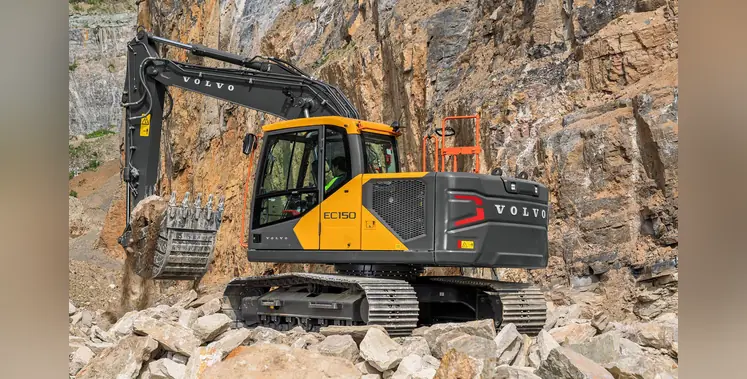
Volvo CE expands excavator range with EC130 and EC150. (Image source: Volvo CE)

Volvo Construction Equipment (Volvo CE) has expanded its crawler excavator portfolio with the launch of the EC130 and EC150 across Africa, the Middle East and Oceania

The new models are designed to help operators improve fuel economy while maintaining productivity, combining positive control hydraulics, intelligent operating modes and fuel-saving functions with the performance and versatility needed for varied jobsite requirements.

Both excavators feature strong digging capabilities, rapid cycle times and simplified maintenance. Their operator-focused design includes an integrated 8-inch Volvo Co-Pilot touchscreen display, bringing key machine functions together in an accessible interface.

“The 13-tonne EC130 and the larger EC150 have been designed around what matters most to our customers — productivity, efficiency, uptime and operator performance,” said Steven Guo, product manager at Volvo CE.

“The result is two machines that make every drop of fuel count while delivering dependable performance, operator comfort and low operating costs,” he adds.

Fuel-saving technology and intelligent hydraulics

Fuel efficiency is central to the design of both models. Volvo's positive control hydraulic system works with the main control valve to supply hydraulic flow according to operating demand. This helps maintain digging power and productivity while limiting unnecessary fuel consumption.

The engine and hydraulic pumps are optimised to match machine output with workload. The EC130 can run at engine speeds as low as 2,000rpm, while the EC150 operates at speeds as low as 2,200rpm. Hydraulic pump flow and pressure adjust continuously to suit changing load and speed requirements. On the EC130, a larger pump than that fitted to the previous generation further supports hydraulic efficiency.

Operators can select from ten work modes to adapt machine response, fuel use and cycle times to specific tasks and site conditions. Automatic engine shut-down and auto-idle functions provide additional opportunities to reduce fuel consumption when full engine output is unnecessary.

Together, these systems are intended to help contractors manage operating expenses while retaining the performance required for demanding excavation work.

Versatility for demanding jobsites

The EC130 and EC150 are built to provide precise control, responsive operation and reliable digging power across a range of applications. The EC150 also accommodates a larger bucket than the previous EC140, allowing operators to handle greater volumes of material with each pass and potentially improve site productivity.

Attachment compatibility extends the machines' application range. Operators can manage attachment settings through a password-protected system on the in-cab display, where hydraulic flow can be configured and stored for up to 20 attachments. This allows frequently used settings to be recalled quickly, helping ensure consistent operation when switching between tasks.

Depending on the attachment and work requirements, operators can choose between one-pump and two-pump flow. X1 constant-flow functionality, including preset options, further supports operation with compatible hydraulic attachments.

These features allow the two excavators to be configured for different jobsite demands while maintaining efficient and controlled performance.

Maintenance designed to maximise uptime

Volvo CE has incorporated extended service intervals and accessible maintenance points into both models to reduce routine servicing demands and help keep equipment available for work.

Engine oil, engine oil filters and fuel filters have replacement intervals of 500 hours. Swing reduction gear oil and the hydraulic oil service filter are scheduled for replacement every 1,000 hours, while the hydraulic oil return filter has a 2,000-hour replacement interval.

Maintenance is further simplified through grouped filters, ground-level service points, quick-drain ports, a swing-out air-conditioning condenser and centralised greasing points. Anti-slip plates and brightly coloured handrails support three-point access to the upper structure from the right-hand side.

The machines also feature durable components, hydraulic hoses designed to minimise leakage and a high-efficiency air filter to protect the engine. These design measures aim to limit wear, reduce maintenance-related downtime and support reliable operation in demanding conditions.

Operator comfort and control

The EC130 and EC150 feature operator environments designed to support comfort, convenience and productivity throughout the working day.

An integrated 8-inch Volvo Co-Pilot touchscreen provides access to essential machine functions and operating settings through an intuitive menu system. This enables operators to adjust configurations to suit the task without navigating unnecessarily complicated controls.

Cab configurations include a choice of seats and joysticks to accommodate operator preferences. Additional features include storage compartments, phone connectivity through the cab display, cup holders, wireless phone charging and USB sockets.

By combining adjustable controls, accessible machine information and everyday convenience features, Volvo CE aims to create a working environment that helps operators remain focused and productive on site.

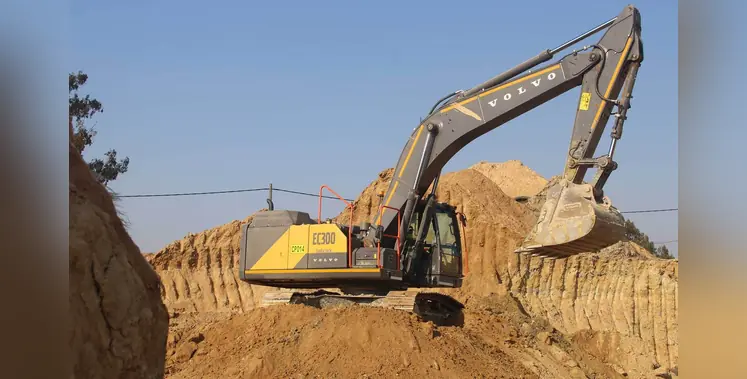
The EC300 also supports Volvo's Dig Assist technology, which includes real-time weighing, automated digging and 360° Smart View monitoring. (Image source: Volvo CE)

Cloete’s Sand and Stone has become the first company in Southern Africa to operate Volvo Construction Equipment’s new-generation EC300 excavator

Supplied by authorised dealer Babcock, the machine introduces updated fuel-efficiency features, enhanced operator comfort and precision technologies to the Gauteng-based construction aggregates supplier.

The delivery builds on a five-year relationship between Cloete’s Sand and Stone and Babcock. The company already operates six Volvo wheel loaders and five Volvo excavators, with the latest addition extending its investment in the manufacturer’s equipment.

Proven performance drives investment

Operating across Gauteng, Cloete’s Sand and Stone selected the EC300 on the strength of its established experience with Volvo machinery. The introduction of the latest model also marks a significant milestone for the business, which has become the first in the region to put the excavator into operation.

"We've had a solid track record with Volvo in general-so stepping into the latest model made perfect sense," said Wesley Cloete, managing director. "Moving dirt is in my blood, and to be honored with the first EC300 in Africa is a proud moment. It's a privilege I'll value for a long time."

Fuel efficiency and productivity in focus

Fuel consumption remains a key consideration for aggregates businesses seeking to manage operating costs. The EC300 offers up to 15% improved fuel efficiency compared with the previous generation, providing an opportunity to reduce fuel use while maintaining the performance required for demanding earthmoving applications.

"We are constantly monitoring fuel consumption across the business. Not doing so would be detrimental to our bottom line, so it's safe to say fuel efficiency is critical," explained Wesley Cloete.

"I was really impressed with how quick the machine was-it moves like a smaller machine but has the capability of a bigger one."

Operator comfort is another feature of the new excavator. Its redesigned cab is intended to improve the working environment and machine control, with Cloete reporting productivity benefits following its introduction.

"If your staff are more comfortable at work, you will get better productivity-and I can confirm productivity has gone up," Cloete noted.

The EC300 also supports Volvo's Dig Assist technology, which includes real-time weighing, automated digging and 360° Smart View monitoring. These functions provide operators with tools to improve digging accuracy, monitor machine activity and manage high-production work more effectively.

Dealer support strengthens the partnership

Babcock's involvement extended beyond supplying the equipment, with its team providing technical information, pricing and maintenance options during the purchasing process.

"All the relevant information I needed was provided with a quote and options within hours of my request," said Wesley Cloete. "It's still early days with the EC300, but I have trust in the brand and I'm happy with Babcock's backup service."

The delivery also highlights the role of long-term customer relationships in introducing new equipment to the South African construction market. Volvo Construction Equipment views the milestone as part of its wider commitment to bringing its latest technologies to regional customers.

"This delivery represents more than just a machine handover-it demonstrates our commitment to bringing Volvo CE's latest innovations," said Per Lorentzon, commercial manager at Volvo CE. "The Cloete's and Babcock teams exemplify the customer-focused approach that drives everything we do, and we're proud to support their continued growth with technology that delivers measurable value."

The EC300 forms part of a broader range of next-generation excavators available across Africa and the Middle East. The portfolio includes six models developed for applications spanning general construction and quarrying.

For Babcock, the delivery reflects its approach to equipment supply, combining machine selection with ongoing customer support.

"Supplying the EC300 to Cloete's Sand and Stone reflects Babcock's focus on matching customers with the right equipment and backing it with dependable support," said Lance Mannix, head of equipment Sales at Babcock. "Their investment is based on proven performance and trust in a partnership that supports their operation throughout the machine's lifecycle."

More Articles …

Page 1 of 164