




vb

twitter Facebook Linkedin acp Contact Us

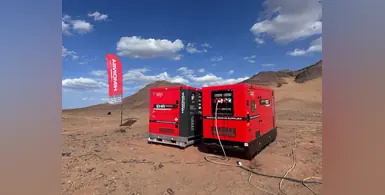
Gensets working in Algeria (Image source: FPT)

FPT, a brand of Iveco Group N.V., and its distributors Bimotor and Avoni Industrial, joined Green Power Systems to power one of Algeria’s largest agro-industrial projects

The new facility is set to transform powdered milk production in the North African country.

The project, worth US$3.5bn and cofounded by the Algerian National Investment Fund and Qatari dairy producer Baladna Q.P.S.C., involves the construction of one of the world’s largest integrated dairy farm and powdered milk facility, spanning 117,000 hectares of agricultural land, and designed to support 270,000 dairy cows.

Located in Algeria’s Adrar province, the agro-industrial facility is scheduled to start production in late 2027.

Once fully operational, it expected to produce up to 100,000 tonnes of powdered milk per year, meeting about 50% of Algeria’s needs.

The gensets provided by Green Power Systems and powered by FPT engines will play a key role in feeding the dairy cows and a huge non-stop irrigation project — a challenging assignment with temperatures often exceeding 40° C for over 130 days a year.

In total, Green Power Systems delivered 50 GP330 S/I-A generator sets powered by FPT CURSOR 13 engines, providing up to 330 kVA, suitable for round-the-clock operation of irrigation systems in extreme conditions.

The FPT-powered Green Power Systems will support central pivot irrigation systems, a crop irrigation method in which the equipment rotates around a central pivot and crops are irrigated using sprinklers, thus creating circular irrigated area centred on the pivot.

Less labour-intensive and more water-efficient, this irrigation method is particularly effective in large plots of arid land and can rapidly transform them into agriculturally productive zones.

“Being part of a such a large-scale project, meant to improve Algeria’s food security and to create about 5,000 local jobs, is both a great honour and a great responsibility,” said Vittorio Bertalli, head of sales EMEA at FPT.

“But we are confident that our CURSOR 13 engines, together with hi-tech Green Power Systems products, will once again live up to the most demanding expectations.”

The CURSOR 13 is designed to deliver robust performance and optimised fuel efficiency for power generation applications, ranging from unregulated to Stage V / Tier 4 Final emissions standards.

Engineered with an electronically controlled unit injector, it ensures precise power delivery, rapid load response, and consistent fuel optimisation under all operational conditions.

The G-Drive configuration provides a ready-to-integrate solution, while highly regulated versions incorporate an ATS pack with patented Hi-eSCR2 technology, enabling advanced emissions reduction without compromising performance.

The engine offers 50/60 Hz frequency switching capability, facilitating inventory management for customers and is designed to maximise uptime and minimise maintenance requirements.

“Green Power Systems’ participation in this project further confirms its role as a reliable international partner in the supply of power generation solutions for large-scale agro-industrial and infrastructure applications,” said Flavio Faggiolini, export area manager for Green Power Systems.

“In projects of this magnitude, power continuity is essential to ensure the proper functioning of the entire infrastructure. The collaboration with FPT Industrial contributed to delivering a solution aligned with the reliability requirements of the operational context.”

Read more:

Nestle sites gain nearly 7MW of solar

GE Vernova drives Africa's industrialisation with integrated power

On-site power for Angolan cold-storage facility 

Daystar Power Group expands solar installations across Nestlé facilities in Côte d’Ivoire, Ghana and Senegal

Daystar Power Group has strengthened its energy partnership with Nestlé across West Africa, with solar installations now fully operational at four manufacturing facilities in Côte d’Ivoire, Ghana and Senegal

The projects bring Nestlé’s total installed solar capacity across these sites to 6,884 kWp, close to 7 MW, making it one of the region’s largest commercial and industrial solar partnerships.

The four facilities, including two sites in Abidjan, one in Tema and one in Dakar, are now operational. Each solar system has been customised to match the specific grid conditions and operational requirements of its respective location.

“Nearly 7 megawatts across four Nestlé facilities is a number we are proud of, but what it represents matters more than the figure itself. It means that one of the world's most demanding manufacturers has tested our model, trusted it, and come back. Our job now is to keep earning that, across every market where industry needs energy it can count on,” added Yischai Beinisch, CEO, Daystar Power Group.

From one site to four sites

The collaboration began with a single installation before expanding across three countries and four manufacturing facilities. In Côte d’Ivoire, Daystar Power has delivered 3,447 kWp of solar capacity across two Abidjan sites. Ghana’s Tema factory now operates with a 2,547 kWp system, while Senegal’s Dakar facility has an 890 kWp installation.

Each project has been designed to deliver measurable environmental and social benefits, including lower greenhouse gas emissions and improved energy resilience. The systems are tailored to local grid conditions and operational demands, providing reliable clean energy access while supporting local development and contributing to Nestlé’s publicly stated net-zero commitments.

“This investment reflects our commitment to building a business that not only grows but does so responsibly. By advancing solar energy projects in Ghana, Côte d'Ivoire, and Senegal, we are embedding sustainability into our growth, reinforcing our role as a force for good, creating long-term value for communities, and ensuring that our footprint actively contributes to a cleaner, more resilient future,” stated Samer Chedid, CEO, Nestlé Central and West Africa Region.

A footprint that keeps growing

Nestlé’s manufacturing network continues to expand across West Africa, including markets where Daystar Power has established strong operational capabilities. With projects now spanning three countries and nearly 7 MW of installed solar capacity, the partnership has created a foundation to support future clean energy expansion.


GE Vernova aims to enable African industries to scale with absolute precision by integrating sustainable energy generation, advanced electrification systems, and sophisticated digital decarbonisation tools.

GE Vernova Inc. demonstrated its commitment to the continent’s economic transformation at the Africa Energy Forum, held in Cape Town, South Africa, on 17 June 2026

Aligning with the event’s central theme, ‘Building Africa's industrialized Future’, the company showcased a comprehensive portfolio of advanced technologies. These innovations are engineered to translate large-scale infrastructure ambitions into tangible operational realities, thereby accelerating Africa's industrialisation and long-term economic growth.

GE Vernova maintains that achieving success in this new industrial era requires a strictly holistic approach, bridging the existing gap between power generation and industrial application. The company aims to enable African industries to scale with absolute precision by integrating sustainable energy generation, advanced electrification systems, and sophisticated digital decarbonisation tools. This integrated strategy ensures that energy provision remains a reliable, affordable, and sustainable foundation for economic transformation.

A key focal point was demonstrating how digital intelligence is accelerating the energy transition. In North Africa, the Tunisian state utility, STEG, identified a strategic opportunity to evaluate GE Vernova's CERius platform. This sophisticated solution integrates artificial intelligence, advanced analytics, and digital twin technology to create a comprehensive digital framework for emissions management. By transitioning from hardware-heavy monitoring towards a streamlined, software-driven framework, STEG is gaining the real-time, auditable emissions data critical for aligning with stringent international standards.

This innovative digital approach has undergone validation at the Sousse B power plant, confirming its operational effectiveness. Beyond achieving a high degree of consistency in emissions monitoring, STEG anticipates this software-driven shift will reduce related investment and maintenance costs by up to fifty per cent. By enhancing traceability, this initiative directly supports Tunisia's ambitious electricity export strategy to Europe. It proves compliance with the European Union's Carbon Border Adjustment Mechanism (CBAM) and demonstrates that data-driven decarbonisation is a powerful catalyst for regional economic growth.

Alongside digital innovation, GE Vernova strongly emphasised that as the African continent accelerates its energy transition, the focus must shift from merely adding capacity to confirming that grid infrastructure is inherently stable and resilient. To support this argument, the company released a new whitepaper entitled, “Spain's 2025 Blackout Experience: Grid Firming Needs for Developing Power Systems with High-Renewable Penetration”. The paper's core recommendation is that future grids must be engineered specifically for fundamental resilience, rather than just basic energy delivery.

GE Vernova encourages African nations to prioritise grid stability from the outset. By applying lessons learned from the Iberian Peninsula, developing power systems can become as reliable as they are sustainable. The company advocates for integrating flexible, grid-forming technologies, such as aeroderivative gas turbines, synchronous condensers, and advanced power electronics. By explicitly valuing grid-support services, Africa can leapfrog traditional infrastructure hurdles. Strategic guidance is further mapped out in another whitepaper, “Ensuring Power System Stability in an Evolving Electrical Grid”.

Joseph Anis, president and CEO of GE Vernova's Gas Power business in Europe, Middle East, and Africa, stated, "Building Africa's industrial future starts with getting the fundamentals right: power that is reliable, sustainable, and ready to scale. A modern, stable grid is the backbone of this vision. Our goal is to provide a complete toolkit - from the AI that manages decarbonization to the grid technology that keeps the system stable - and to partner with African leaders to make that future a reality."

Building upon over 125 years of collaboration across the continent, GE Vernova continues to support Africa's energy evolution. The business is headquartered in Cambridge, Massachusetts, and supported by approximately 85,000 employees globally, and brings over 130 years of broader experience to tackling global challenges. Through its deep-rooted continental presence, the purpose-built global energy company remains actively committed to fostering the technical self-sufficiency required to power the next generation of industrial growth.

Louis Botha, country manager, South Africa, at Aggreko (Image source: Aggreko)

Louis Botha, country manager, South Africa, at Aggreko, talks about the value of power resilience and reliability with behind-the-meter solutions for African manufacturers

Sub-Saharan Africa's infrastructure challenge is gradually evolving, with the Africa Infrastructure Development Index (AIDI) score increasing by 50% from 2003 to 2025. It has been a slow, uphill challenge, impacted by funding, governance, and legacy issues and its limitations have played no small role in depressing productivity and competitiveness across the continent. According to the World Bank's April 2026 Africa Economic Update, public capital investment has dipped to 20% below 2014 levels. The report, highlighting ongoing economic and geopolitical shocks as central to the continent’s issues, underscored the difficulties faced by countries to fund the infrastructure they need. Infrastructure has long dragged on private-sector productivity and manufacturing cost structures.

Power remains central to the challenge. A recent study by the Centre for Global Development in sub-Saharan Africa found that unreliable power can cost companies as much as 31% in sales. Across 37 African countries and more than 3,000 companies, the study examined how power outages affected the business. Nigeria, Angola, and Ghana lost significant sales, averaging 31%, and across the continent, some companies are barely surviving with low growth, thanks to the cost of keeping the lights on. African manufacturers are operating in far tougher conditions than their global counterparts, and yet they are still delivering innovation and value.

Despite steady advancements in energy infrastructure, manufacturers are still climbing the hill towards power reliability. It is time for this narrative to change, with solutions and approaches designed to meet the market where it lives today. Generators have kept manufacturers running throughout the lights-on, lights-off years and have remained the backup plan that has allowed factories to ride out grid pressure and keep their customers supplied. They have become foundational to ensuring that companies have their own infrastructure. Still, there is a change in how companies approach the use of generators and the structure of their energy portfolios.

Behind-the-meter (BTM) power applies the same on-site principle as diesel backup and extends it to include more fuel options, greater control, and a better position on costs and emissions. In Africa, BTM is defined as generator or storage assets, such as solar PV, batteries, diesel or hybrid microgrids, that manufacturers own directly and that allow them to bypass the grid for part of their power load. The size of a BTM operation depends entirely on the manufacturer's needs. You can have a gas generator designed to meet peak demand, a diesel set with battery storage to even out your fuel use, or a hybrid setup that includes solar to reduce your runtime hours and costs.

The BTM principle is the same as the generator backup plan. The power structure on your premises is designed to support your assets and uptime, ensuring reliable energy in the event of infrastructure failure. You can then balance the load and structure it so it stops being a mere emergency response and becomes a strategic part of your operation's infrastructure.

The challenge for BTM comes down to how you plan and design the energy mix behind it. There is no best single source of energy anymore. Each solution has its own value and drawbacks. You want to create a portfolio that is optimised for your operation and that features energy solutions that complement one another's strengths and trade-offs.

Solar is the obvious clean choice, but its output is limited by daylight and weather, and it can struggle with large block loads. While battery energy storage (BES) has revolutionised solar energy storage, shifting energy to when it is unavailable, it doesn't generate power on its own. Gas performs well as a stable base-load solution, but it is slow to respond to sharp load changes. Diesel is still the most responsive option, but it comes at a high operating cost. Utility supply can absorb sudden demand, but peak tariffs are expensive, and availability is outside your control.

The most resilient energy strategy combines these sources, or some of each, into a customised system that fits your load profile, cost objectives and risk tolerance, ensuring your energy infrastructure is predictable and reliable. And under your control. This reliability shift changes the manufacturer's productivity narrative because energy is now a planning input. After all, power is on your site and on your terms.

As the energy outlook remains volatile and complex, BTM offers manufacturers control and visibility into their energy provisioning and costs. Instead of carrying grid risk, you can now create a solution that sits on your side of the meter and gives you more ways to keep your production lines moving. And the number of energy options has also increased significantly over the past five years, giving you choice without compromise. It's not as complex today to build your own BTM as it was five years ago; choose the right partner and collaborate on an approach that blends the tools to fit your goals.

Read more:

MTN Nigeria builds low-carbon network future

On-site power for Angolan cold-storage facility

Boakai commissions Mount Coffee solar plant 

MTN Nigeria expands renewable power infrastructure

First WATT Renewable Limited and MTN Nigeria have entered into a strategic renewable energy infrastructure partnership aimed at reducing reliance on diesel power, enhancing resilience at critical telecommunications facilities, and supporting renewable energy solutions for electric vehicle (EV) charging infrastructure across selected MTN locations in Nigeria

The initiative consists of two key components. The first involves an Energy-as-a-Service deployment that will deliver approximately 34 MWp of solar photovoltaic generation capacity and 40 MWh of battery energy storage across selected MTN facilities nationwide. These locations include data centres, switch facilities, cable landing stations, customer service centres, and other network-critical sites.

The second component focuses on providing renewable energy infrastructure to support 60 kW EV charging stations at eight MTN facilities in Ikoyi, Matori, Ojota, Abuja, Port Harcourt, Asaba, Kano, and Ibadan.

Together, the projects are designed to reduce dependence on diesel-powered systems, decrease operational emissions, improve uptime, strengthen business continuity, and increase the adoption of renewable energy solutions across MTN’s operational facilities and EV charging locations.

With digital services continuing to expand, dependable energy infrastructure has become increasingly important for maintaining telecommunications networks and supporting the broader digital economy. Through this partnership, MTN Nigeria aims to improve the resilience of its critical operations while increasing the integration of renewable energy across selected sites.

Based on current project assumptions, the programme is expected to help avoid approximately 25,000 tonnes of carbon dioxide equivalent emissions (tCO₂e) over five years, subject to operational performance and final emissions assessments.

Commenting on the partnership, Oluwole Eweje, CEO of WATT Renewable Corporation, said, “This partnership is a defining milestone for First WATT and an important step in strengthening the energy infrastructure that supports Nigeria’s digital economy. By deploying solar photovoltaic generation and battery energy storage across selected MTN facilities, we are helping to improve energy reliability at critical locations where uptime is essential.

“The EV charging component also demonstrates how renewable energy infrastructure can support Nigeria’s transition to lower-carbon mobility. By providing renewable power systems for EV charging sites, this programme helps address one of the key requirements for wider EV adoption: reliable and cleaner energy supply.”

Speaking on the initiative, Tobechukwu Okigbo, chief corporate services and sustainability officer at MTN Nigeria, stated, “As Nigeria’s energy and mobility landscape evolves, renewable energy will play an important role in building cleaner and more reliable infrastructure. This partnership supports our efforts to reduce diesel dependence, improve operational efficiency, and strengthen the resilience of the systems that power connectivity.

“It is also aligned with Project Zero, under our Doing for Planet sustainability pillar, through which we are focused on reducing greenhouse gas emissions, improving energy efficiency, and increasing the use of renewable energy across our operations.”

More Articles …